Language
 English

45 years ago the Treaty of Osimo
November 10, 1975, Treaty of Osimo: if September 8 outrages you, this date should make you scream with rage
by Davide Rossi and Lorenzo Salimbeni – 10/11/2020
Source: the Adige
The end of the First World War in November 1918 did not mean the immediate pacification of the Continent, tormented by nationalist claims eager to overturn the borders and by revolutionary ferments inspired by the Bolshevik revolution. Gabriele d'Annunzio's expedition to Fiume at the head of his legionaries represented for Italy the most striking appendix of the conflict, while military missions were deployed in various crisis areas (Carinthia, Silesia, etc.) and a significant contingent tried to keep turbulent Albania under control. Once the northern Italian border with Austria had been established by the Treaty of Saint-Germain, it was the Treaty of Rapallo, signed on 12 November 1920, that would define the border with the Kingdom of Serbs, Croats and Slovenes, moving the border established at the end of the Third War of Independence, over half a century earlier, along the Iudrio River and therefore significantly further east (so much so as to include approximately 400.000 Slovenes and Croats). After so much immobility, the story of what has been defined as “the mobile border” began, in light of the many adjustments it would undergo in the twentieth century.
In Rapallo, not only was the border drawn along the Julian Alps watershed between Italy and what a few years later would become the Kingdom of Yugoslavia, but the Free State of Fiume was also created, which, once the Italian Regency of Carnaro was evacuated with the fighting of the Bloody Christmas, would have a short life. Already in March 1922, local irredentists, supported by squadristi, overthrew the elected president Riccardo Zanella, creating the conditions for the subsequent agreements between Rome and Belgrade, which in 1924 led to the division of the small state and the annexation of Fiume to Italy.
In the spring of 1941, the Second World War also hit Yugoslavia, which was quickly defeated by Axis troops and divided up at the table: southern Slovenia (as the autonomous province of Ljubljana), Split (with a special regime to facilitate communications and trade with the Independent State of Croatia) and Cattaro were annexed to Italy, which went on to form the Governorate of Dalmatia together with Zadar (which had become part of the Kingdom of Italy as an exclave already as a result of the Treaty of Rapallo). The catastrophe of September 8, 1943 led to the invasion in force of both the Yugoslav partisan bands that unleashed the first wave of massacres in the foibe (a thousand victims in the Istrian hinterland and in Dalmatia) and of the German troops: with the exception of Zadar, which remained linked to the Italian Social Republic, the rest of Dalmatia was attributed to the Croatia of the poglavnik Ante Pavelić, while the provinces of Udine, Gorizia, Ljubljana, Trieste, Pola and Fiume were included in the Operational Zone of the Adriatic Coast, a military Governorate in which the powers of the RSI were minimal. The end of the conflict led to the occupation of Venezia Giulia and Fiume by the Yugoslav army, to the Anglo-American intervention that drove the communist militias from Trieste, Gorizia and Pola after 40 days of massacres in the foibe and to the dispute over the redefinition of the Italian-Yugoslav border.
The Peace Treaty signed in Paris on 10 February 1947, by which Istria, Fiume and Zara, where 90% of the native Italian community was exodus, were ceded to Tito's Yugoslavia, was not sufficient to resolve these issues, since in 1954 Trieste passed to the Italian civil administration and the former Zone B of the never-established Free Territory of Trieste to the Yugoslav civil administration. The great celebrations of 4 November 1954 reaffirmed the Italian nature of the Julian capital and the question of the eastern border began to disappear from the attention of national public opinion.
Yet the story was not over yet.
From a strictly internationalist point of view, in fact, sovereignty over the districts of Buie and Capodistria was still formally Italian, Belgrade's presence being theoretically only administrative. On the other hand, the London Memorandum that in October 1954 had created the conditions for the end of the Anglo-American military administration in Trieste (Zone A) and Yugoslavian in Zone B, also playing on technicalities and linguistic ambiguities, left the task of concluding the matter to bilateral negotiations between Rome and Belgrade. The rhetoric of the communist dictatorship never missed an opportunity (especially in moments of political and economic crisis) to rekindle spirits regarding the fate of Trieste; while on the Italian side the collapse of patriotism and interest in the historically Italian lands of the eastern Adriatic left the question of the eastern border to the exclusive prerogative of the MSI parliamentary opposition, of the claims of the associations of Adriatic exiles and of the local political debate, with the city of San Giusto being on the front line and thousands of Istrian refugees having flocked there. The big Italian companies saw in nominally socialist Yugoslavia, but open to Western influences, an interesting partner, so much so that FIAT opened factories in Kragujevac producing Zastava with Italian patents (in the photo the visit of the dictator Tito to Fiat with Gianni Agnelli) and ENI interfaced with the Croatian oil company to start drilling in the Adriatic.
Why bother with these affairs with territorial claims that were so patriotic? The Sixty-eight movement with its slogans and ideas would have definitively put the national interest in second place compared to social and civil claims. Furthermore, the openings to the left of the Christian Democracy were aimed at socialists and communists, who – in different measures and forms – had in the Titoist model a point of reference, from his position as a Third World Non-Aligned to the figure of a partisan fighter (we are in the years in which the resistance vulgate definitively takes hold), passing through his economic model of self-management.
Awarded a high honor by the Italian Republic during a state visit and praised by workers during a visit to Fiat in Turin, Josip Broz “Tito” was a privileged interlocutor from whom territorial relegation could certainly not be asked, especially since the United States was pushing for an official conclusion to the border dispute in order to stabilize a regime that the student protests in Zagreb had risked casting in a bad light. While Italian diplomacy was trying to maneuver to obtain adequate compensation, Aldo Moro wanted to imitate Willy Brandt's Ostpolitik and, in the climate of détente that followed the Helsinki conference on the stability of borders in Europe, he activated a secret channel of negotiation with Belgrade. The Farnesina was bypassed and it was Eugenio Carbone, the ambiguous and much-talked-about director general of the Ministry of Industry, as well as a loyal follower of the Apulian statesman, who led the negotiations that would lead to the Osimo agreements.
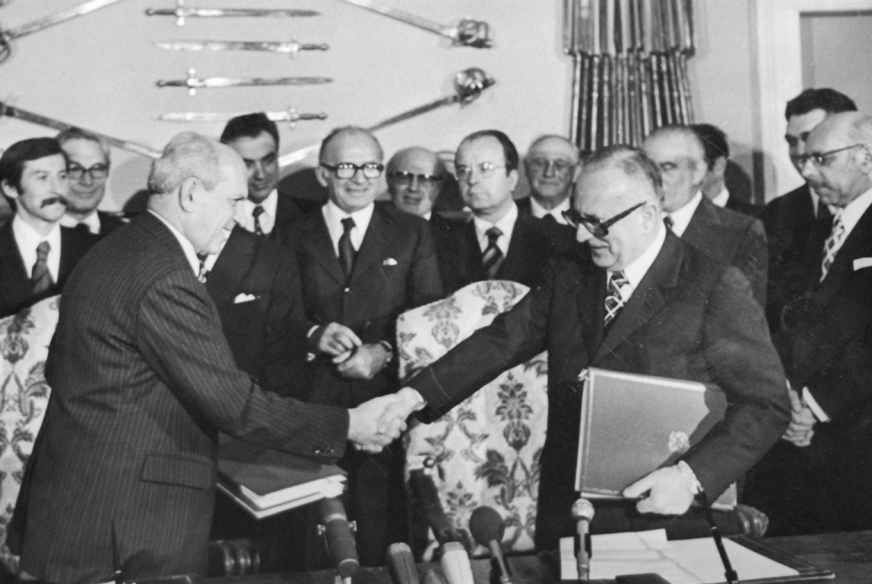
In the Marche region on 10 November 1975, in a sudden and almost clandestine manner, the Italian and Yugoslav plenipotentiaries signed the Treaty that recognised Yugoslav sovereignty over the districts of Capodistria (now in Slovenia) and Buie (now in Croatia) and reaffirmed Italian sovereignty over Trieste, close to which the creation of an Industrial Free Zone was planned. It would have been an eyesore that would have devastated the Karst plateau, a cathedral in the desert that would have attracted Italian capital (primarily in the automotive sector) and low-cost Yugoslav labour, which would have given rise to a significant residential settlement close to Trieste, a city that lived, mindful of the massacres of spring 1945, always in anguish of finding itself embedded in Yugoslav territory in an easily attackable position. Patriotic and environmental considerations, the surprise (even on the part of local representatives of the government forces) at having found themselves faced with a fait accompli without any involvement in the decision-making process that had led to a resolution so impactful for the Julian capital and the desperation of the exile community, who saw yet another transfer of their lands of origin to Yugoslavia in exchange for nothing, led to significant protests.
While in the rest of Italy the news went almost unnoticed, in Trieste exiles and MSI youth organizations led the protests in the square, while a growing consensus gathered around a transversal committee that, instead of a purely economic measure, called for the establishment of a Free Zone for the entire province, reaffirmed its Italianness expressed according to the application of effective autonomy and rejected the industrial project on the Carso plateau. The excessive power of the Christian Democrats in the city was overwhelmed by the Lista per Trieste that was born from this civic movement and brought one of its leaders, the liberal Manlio Cecovini, to the seat of Mayor in a City Council that included Giorgio Almirante and Marco Pannella among those elected. The political laboratory of Trieste in fact, ahead of the rest of Italy, paved the way for the phenomenon of local civic spirit (so much so that the Northern League, in taking its first steps, looked precisely to that experience), spoke openly of the fight against party politics and forced the Roman powers to withdraw from such invasive intentions regarding the Julian hinterland (an amazing waterway from Monfalcone to Ljubljana had also been hypothesized, which did not take into consideration the local geomorphology).
The subsequent Rome agreements defined the paltry compensation that Belgrade had to pay to the legitimate owners who had seen their real estate confiscated and nationalized in the former Zone B of the never-established Free Territory of Trieste, with an installment plan that provided for the first payment in 1990. The implosion of Yugoslavia interrupted this financial flow, whose inheritance went to the successor states for territorial competence, Slovenia and Croatia. Ljubljana paid a sum established unilaterally and Zagreb has not yet addressed the issue, all in the inertia of Italian diplomacy. While Tangentopoli was raging in Italy, the recognition of Slovenian and Croatian independence was not subordinated to the renegotiation (or any other form of compensation) of the border set in Osimo.
It seems that on that 10th November 1975 the border was determined in an unchangeable manner and that the national interest, which should have directed foreign policy in the former Yugoslavia, was considered a sovereignist frill that could be done without.