Language
 English

The “Norma Cossetto – February 10th” Award goes to Lucio De Priamo
The Roman lawyer made available to RAI unpublished images of the recovery of the bodies from the Julian foibe
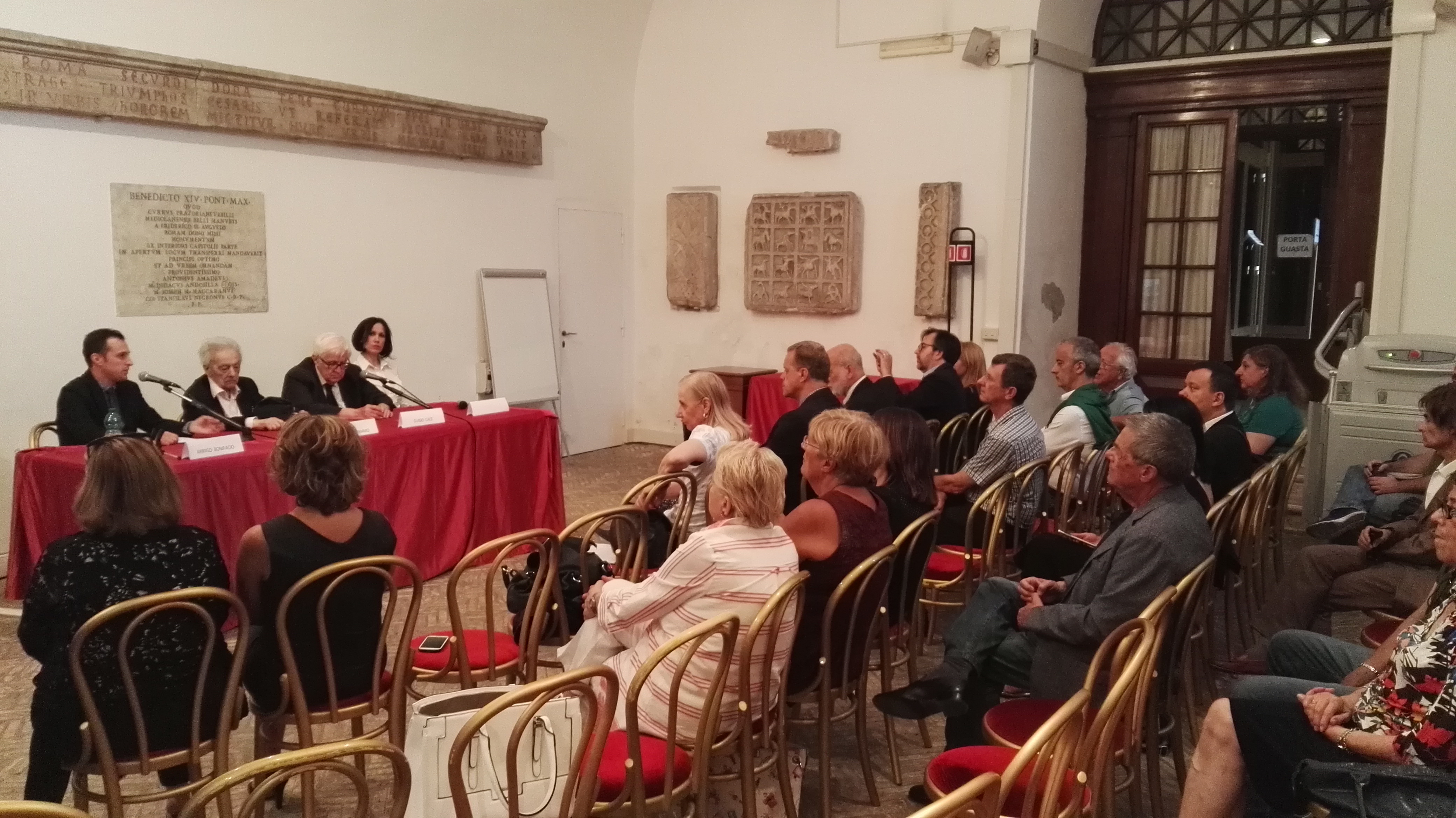
"I fought proudly to bring this censored page of history to light, but I did nothing exceptional: I simply did my duty as an Italian," said with emotion the lawyer Lucio De Priamo, awarded the "Norma Cossetto - 10 Febbraio" Prize on Wednesday 27 June at the Sala del Carroccio of the Municipality of Rome. The Comitato 10 Febbraio had awarded this recognition in its first edition to Simone Cristicchi and Jan Bernas, for their work in disseminating the history of the eastern border carried out in a masterly manner with their work “Magazzino 18”, this time the plaque was awarded to the person who brought to light invaluable period images, then only partially circulated, regarding the recovery of the bodies of those thrown into the sinkholes from the cavities of the Trieste Karst in the summer of 1945. Carla Isabella Elena Cace illustrated the meaning of this event: «Four out of five Italians still ignore the meaning of the sinkholes – explained the national director of the C10F – and with this plaque we want to thank those who, even those without family and territorial connections with these tragic events, have worked to spread knowledge of them»
Coordinating the event, researcher Arrigo Bonifacio, affiliated with Sapienza and member of the Scientific Committee of the February 10 Committee, recalled the importance of audiovisual and oral sources in historiographical reconstruction, while Guido Cace began to explain the story in which De Priamo was the protagonist: «In the 1948s, the wars in former Yugoslavia allowed the history of the massacres in the foibe to re-emerge, seen as a precedent for the ongoing massacres – said the president of the Dalmatian National Association – after a blanket of silence had fallen for half a century». The role of the Italian Communist Party in supporting Tito's partisans in their territorial claims and in the massacres of our fellow countrymen, as well as Tito's repositioning as an interlocutor of the Western bloc in the Cold War after the break with Stalin in XNUMX, have been identified as the causes of the prolonged removal of these pages of national history: «Through Claudio Schwarzenberg, at the time Mayor of the Free Municipality of Fiume in exile, I got in touch with De Priamo – continued Cace – and together we examined some films that my association and I had found in the archives of the Istituto Luce: it was material that had appeared in the news bulletins of the Settimana Incom, but it was incomplete»
This is where lawyer De Priamo comes into play, who, before intervening in the debate, was awarded with the following motivation:
«For having discovered, from a locked drawer, a page of denied history and, with rigor and professionalism, having inserted it into the common history of our Nation, marking a before and after for the history of the eastern border.
For having given the images, the sounds and the pain – that pain that terrifies but brings to life – to a story of defeated Italianness.
For having taught wherever possible that beyond the water there existed, and still exists, part of our history. And part of us.
For having demonstrated that a man's greatness is measured by his actions but also and above all by those he is capable of inspiring in those who have his blood or, even more, in those who follow his example.
For never having asked for any recognition other than knowing that one had done one's duty.
For having demonstrated that “being Italian twice” continues to mean that once you were born here, once you deserved to call yourself Italian.
And finally, because here, in the place where civilization was born, because here where from the window you can see an arena that on a large scale recalls that of Pola, immortal words can finally resound without fear of being wasted, the words of the Poet can be pronounced who from Fiume d'Italia still push us to be Italians while describing that the whole man is he who knows how to offer his brothers a new gift every day; work, even the humblest, even the most obscure, if it is well done, tends towards beauty and adorns the world".
For these reasons and for all those that our history knows and will recognize, the 10th February Committee with all its members - from Trieste to Cagliari, from Trento to Catania and wherever the yearning for Italianness becomes thought and action - unanimously awards the "Norma Cossetto - 10th February" Award to the lawyer Lucio De Priamo»
Although he was born and raised in the capital, De Priamo has the events of the eastern Italian border engraved in his DNA: "I was already 12 years old when I took to the streets for Italian Trieste - the award winner recalled - at a time when communist militants hunted down those who demonstrated against comrade Tito. Today, one of the main streets in Rome is named after the leader of that PCI, who was ready to bargain Trieste and Gorizia with the Yugoslav dictator, but finally the story of those who died in the foibe also gets space and some initial form of justice. Receiving this award today makes me proud and happy, it is a victory of the Italian heart"
When Cace and Schwarzenberg accompanied De Priamo to the Istituto Luce to screen the original films in his possession, it was immediately clear that what had been broadcast in the 1940s was censored: "My friend Stefano Barraco," De Priamo explained, "told me that in the cellar of an uncle of his who lived in Trieste and had recently passed away there were some unpublished films, for which he had received death threats. I didn't hesitate for a moment and came into possession of documents that dismantled the heavy anti-Italian and pro-Yugoslav conclusions of the Combat Films that Rai had screened: thanks to the National Dalmatian Association we were able to digitize them and broadcast them, as well as entrust them to Rai so that it could use them in its programming."
The President of the Federation of Associations of Istrian, Fiume and Dalmatian Exiles Antonio Ballarin then reiterated the importance of these crude images and recalled the many issues that the people of the exodus still have open with the Italian State (from compensation for abandoned goods to the Gold Medal for Military Valor to be pinned on the banner of the Municipality of Zara, the most bombed Italian city during the Second World War). Marino Micich, director of the Historical Archive Museum of Fiume in the Julian-Dalmatian Quarter on the southern outskirts of Rome, recognized that De Priamo's patriotic fervor was also reflected in his family, since his son Andrea was one of the city councilors who did the most during the Alemanno administration to ensure that the House of Remembrance was identified and made operational and was also among the promoters of the Journey of Remembrance. When called into question, the current Vice President of the Capitoline Assembly declared that he had become aware that the Julian-Dalmatian exiles had paid the price for the defeat of Italy as a whole by themselves and had therefore directed much of his political action towards the aim of rendering justice to these fellow countrymen of ours: his party, Fratelli d'Italia, on the other hand, recently prevented a public space in Genoa from being granted to the organizers of a conference justifying the massacres of the foibe.
Concluding the emotional event, Emanuele Merlino, Vice President of the 10th February Committee, informed the public that he will soon collaborate with the editorial staff of the popular Rai programme “Linea Verde” in the creation of an episode set in Trieste and dedicated to the Basovizza Foiba, Warehouse 18 in the Old Port, the Padriciano Refugee Collection Centre and the Plutone Abyss, while the President of the C10F Michele Pigliucci finally reiterated that Remembrance cannot be confined to the anniversaries scheduled around 10th February, but must be a commitment that lasts all year round.
Lorenzo Salimbeni
Source: February 10 Committee