Language
 English

Forty years after Osimo, the Adriatic Coordination conference
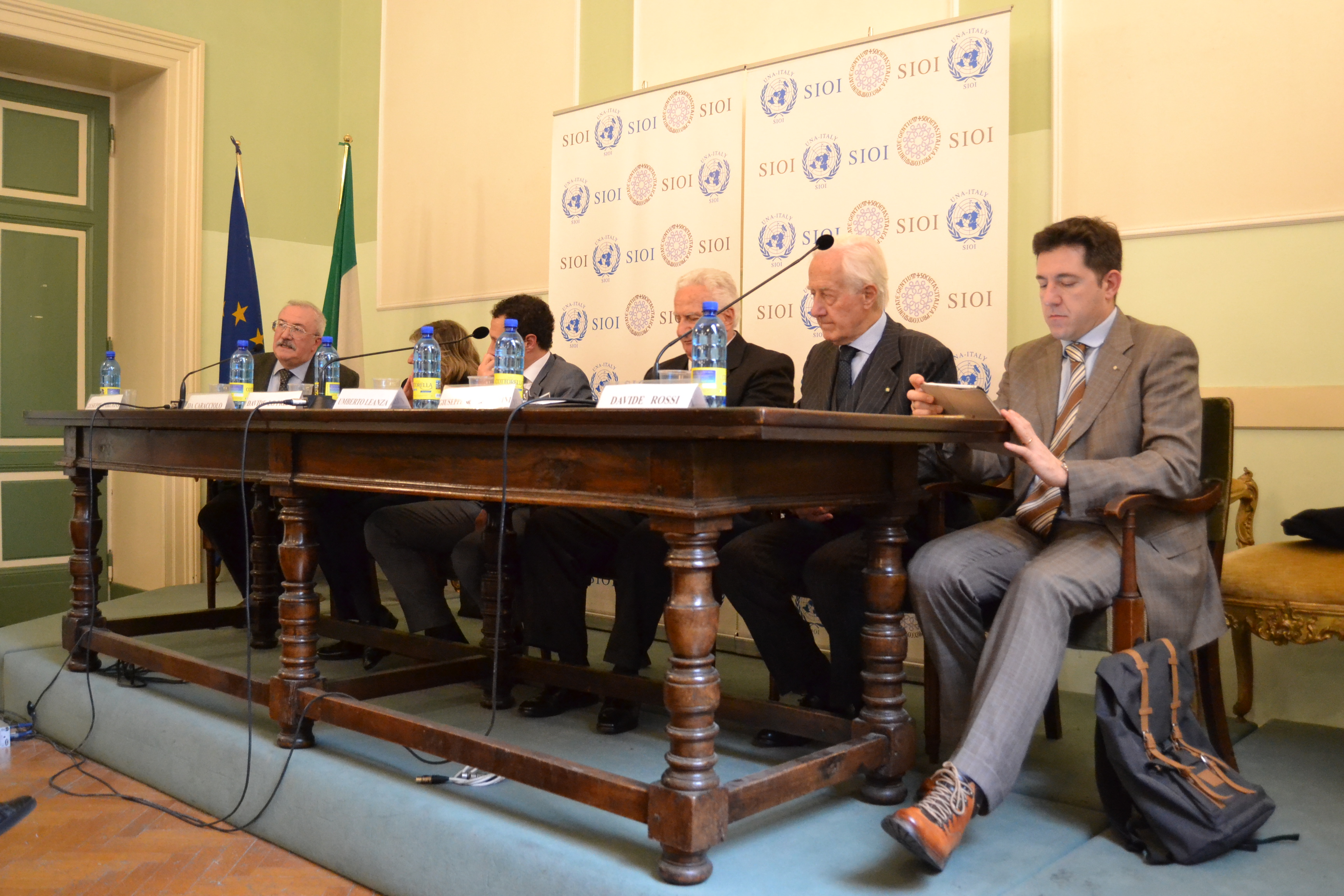
The prestigious setting of the Italian Society for International Organization, an attentive audience of both industry professionals and students interested in international relations, a lively debate, and extensive and detailed presentations characterized the conference "Forty Years after Osimo. The Italo-Yugoslav Treaty of November 10, 1975," organized by the Adriatic Coordination Association in collaboration with the SIOI on Monday, January 11, 2016.
Professor Giuseppe Parlato, a lecturer in Contemporary History at the University of International Studies in Rome, provided the historical context for the affair, emphasizing at length the awe that center-left Italian governments displayed toward Tito's shaky Yugoslavia. While the centrist government addressed the issue of the eastern border and the phantom Free Territory of Trieste with the hope of reconciling the ethnic divide along the Istrian coast, from the mid-1960s onward, Aldo Moro and the Italian Socialist Party initiated an Ostpolitik that appeared poised for the widest concessions toward Belgrade. The economic model of self-management, the myth of the anti-fascist struggle, and the Non-Aligned Movement's alignment during the Cold War were, in the eyes of the Italian ruling class of the time, elements of prestige capable of obscuring the economic crisis affecting the Federal Republic, the turmoil in Kosovo and Macedonia, and Tito's fears of being affected by the application of the Brezhnev doctrine of limited sovereignty. Rather than wait for the death of Yugoslavia's elderly father-master, Italian diplomacy preferred to open underground channels of negotiation through which an agreement could be reached, albeit in a strange and unconventional manner, so much so that the main architect was Eugenio Carbone, Director General of the Ministry of Industry. Huge negotiations were conducted to reach a futile agreement, according to Sergio Romano; A ruling class incapable of protecting the national interest was revealed, as written by Massimo De Leonardis: the protests in the Trieste square and by the community of Istrian, Fiume and Dalmatian exiles, not taken into consideration during the very laborious preliminaries of the agreement, were tangible proof of the criticisms raised by authoritative historians of international treaties.
We then moved on to the legal aspects of the affair with the report by Professor Umberto Leanza, not only a former lecturer in International Law at the University of Tor Vergata in Rome, but also a member of the technical commission Exiles-Ministry of Foreign Affairs launched by Minister Renato Ruggero in 2001. Perhaps because the first meetings with the Slovenian and Croatian counterparts took place on the fateful 11th September of that year, but the process aimed at providing a complete picture of the abandoned assets, with reference not only to Zone A and Zone B of the phantom FTT, brought few concrete benefits to the cause of the exiles. However, 700 assets emerged that had escaped the calculation on the basis of which the lump sum compensation was established and cases of expropriation, nationalization and confiscation prior to the signing of the Peace Treaty were highlighted, carried out by Belgrade in contempt of the international norms that regulate the regimes of Military Administration, such as Zone B outlined by the Belgrade Agreement of 9 June 1945. Slovenia and Croatia would later prove to be worthy successor states in failing to pay the compensation due to them. The Rome agreements of 1983, in fact, imposed on Yugoslavia, with reference to the assets abandoned in the former Zone B of the FTT, the payment of 110 million dollars in thirteen annual instalments starting from 1990 January XNUMX: the first two instalments were paid by the federal government, but the implosion of the neighbouring republic then shifted this burden to Ljubljana and Zagreb. The latter were found to be in default in the payments due to them, so much so as to configure conditions of nullity of the agreements and consequent possible request for restitution of the goods in question, which was now materially unfeasible, but there was certainly room for requesting to top up the compensation, something that the Italian State did not do with adequate conviction.
Professor Ida Caracciolo of the Second University of International Studies in Naples linked the Treaty of Osimo to the Helsinki Conference on Security and Cooperation held in the summer of 1975, a meeting capable of creating the climate of collaboration necessary to conclude the intricate negotiations. Regarding the definition of the land border, Italy's transfer of sovereignty had its roots in the 1954 London Memorandum, under which civilian administrations replaced military governments, which by definition were limited in time. At Osimo, territorial waters were precisely defined. A medium of 29 kilometers was established based on the principle of equidistance from the coast, but navigability was uneven, being biased in favor of the Yugoslav side. Although established international law allowed for adjustments to achieve a more equitable situation, the Italian delegation did not consider this. Furthermore, the Osimo agreement abrogated the London Memorandum, including the Minority Statute, requiring the parties to implement new rules aligning them with the defunct Statute, giving rise to an interpretative misunderstanding regarding the extension of protections for minorities not resident in the former Zones A and B. With reference to compensation, the professor emphasized how Article 76 of the Peace Treaty unequally imposed on Italy the waiver of its right to request reparations: Osimo waived the right to compensation, which Yugoslavia, as mentioned, began to pay in installments; Slovenia paid its due amount into a current account at the Dresdner Bank in Luxembourg; and Croatia paid nothing. It must be noted, however, that the agreement between Ljubljana and Zagreb aimed at sharing this burden would not be valid under international law, which requires a trilateral agreement: Italy's inertia was deemed to be a tacit consent.
Numerous institutional interventions and those of representatives of the exiles provided ideas for the debate and enriched the arguments presented, starting from the Undersecretary of State at the Ministry of Foreign Affairs and International Cooperation Benedetto Della Vedova to reach the President of the Federation of Istrian, Fiuman and Dalmatian Exiles Antonio Ballarin, passing through Senator Lucio Toth, the President of the executive board of the Italian Union Maurizio Tremul and many others.
Concluding the day, Giuseppe de Vergottini, Professor Emeritus of Constitutional Law at the Alma Mater Studiorum University of Bologna, focused on the history of Italian-Yugoslav relations, observing in the Balkan counterpart a tenacious policy of asserting power and a propensity to annex new territories without respect for basic human rights. The September 8 catastrophe, combined with the unconditional surrender, acceptance of the Peace Treaties, and acknowledgment of responsibility for the invasion of Yugoslavia in 1941, shaped the attitude of our ruling class. Turning to the Treaty of Osimo, the distinguished jurist found incredible weaknesses, from the futuristic Isonzo waterway, which was supposed to connect the Danube to the Adriatic, to the absurdity of the Mixed Economic Zone. The Julian protests led to the creation of the Lista per Trieste, the first anti-party movement and the forerunner of civic lists. Among other things, it realized that no benefits would come from the feared Karst Economic Zone, which would soon become a gateway for low-cost Yugoslavian labor. Furthermore, by approaching bilateral negotiations, the Yugoslavs' sovereignty over Zone B was now untouchable, while Italy's ambiguous attitude persisted, leading to the self-deception of presenting the word " boundery" (border line) in the Chamber of Deputies' official translation as a line of demarcation, a term that left room for renegotiation. In 1964, the Constitutional Court reiterated that Italian sovereignty had not lapsed over either Zone A or Zone B of the FTT, but was merely "non-exercisable," given the provisional and extraordinary nature of the London Memorandum, an anomalous and exceptional document: Italian diplomacy was unable to enforce legitimate rights.
Finally, we remind you that it is possible to listen to the full recording of the conference on the Radio Radicale website: https://www.radioradicale.it/scheda/463361/a-quarantanni-da-osimo-il-trattato-italo-jugoslavo-del-10-novembre-1975
Lorenzo Salimbeni