Language
 English

Forgotten Arsia
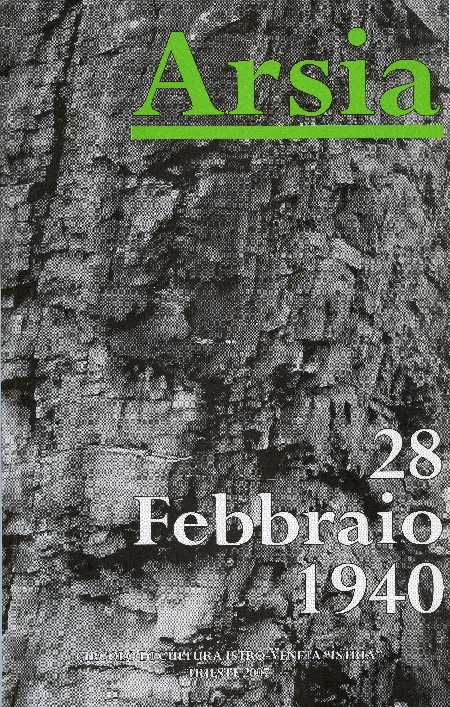
Excerpt from the teleconference “The mining tragedy of Arsia 28 February 1940” held by the Provincial Committee of Milan of the National Association of Venezia Giulia and Dalmatia on Thursday 11 March 2021.
PREAMBLE
If Vergarolla must be considered the bloodiest massacre in Italy since the proclamation of the republic to date, the tragedy of Arsia, an Istrian coal district, constitutes the most painful mining tragedy, with victims that far exceed those recorded in Marcinelle in Belgium.
Livio Dorigo, president of the Istria Club, notes in the preface to the monograph “ARSIA 2007”:
The border events have produced a repression of the Arsa dead: the fallen were considered Croats by Italy, Italians and moreover fascists by the Croats. In reality among the workers and the fallen there were Italians, Slovenes and Croats (evidently a great mix), as well as immigrants from all of northern Italy, from Tuscany and Sardinia.
It has not been talked about for a long time and in this post I would like to renew the memory of it.
THE TRAGEDY
A central figure in the history of Arsia is one of its leaders, Eng. Augusto Batini, who left us a rich, exhaustive collection of letters, and I would like to begin with him.
But first I would like to briefly outline the history, which begins in the Venetian era, when it was thought to exploit the coal deposit.
The real exploitation began in the nineteenth century, with the Habsburgs, who entrusted the enterprise first to private capital (the Brunner family of Trieste), then, following their bankruptcy, to public capital, through a company based in Vienna.
Once Italy took over, the company consolidated its ownership by transferring it to an entity that coordinated all the coal mines in Italy from Rome.
There were episodes of discontent, culminating with the occupation of the mine during the parenthesis of the proclamation of the Republic of Albona in 1921.
In Labin, approximately 2.000 miners of various nationalities (Italians, Germans, Croatians, Slovenians, Czechoslovakians, Poles and Hungarians) created the Soviet-style Labin Republic, following the beating in Pisino of the Trieste trade unionist Giovanni Pipan by a fascist squad.
After 35 days, the Republic was repressed by the Carabinieri in a short time, two victims. The Court of the Kingdom of Italy, however, acquitted all the rebels.
The Italian government modernized the plants, providing for their electrification, but the economic prospects of the Arsia mining enterprise did not improve much, certainly due to the difficulties in selling coal on an international basis. As a consequence, the economic situation of the Istrian peninsula was also forced to languish. But a change occurred in the following years.
Anna Millo writes (from Irsml FVG) Regional Institute for the History of the Liberation Movement)
The dilemma represented by Istrian coal was solved in 1935, when – after the economic sanctions proclaimed by the League of Nations against Italy – Acai was created, a company with mixed public and private capital, which owned both Arsa and the Sardinian mines of Sulcis, as part of a program created to enhance the production of Italian coal. From here the industrial growth of Arsa began. In 1935, approximately 350.000 tons were produced with 1839 workers, in 1936 production and the number of workers doubled, in 1939 one million tons were reached with almost 9.000 workers. Arsa had become the largest mine in Italy
Mining engineer Augusto Batini entered service in the Arsia mines in 1926. From 1936 until 1939 he held the position of General Director.
From the Batini Archive:
The main architect of this amazing economic development was the entrepreneur from Trieste Guido Segre who in 1935, with the establishment of the Azienda Carboni Italiani (A.Ca.I.), not only connected the Sardinian mines with those in Istria, but marked a decisive turning point in the development of the respective mining basins with the aim of ensuring the autarchic fascist economy the greatest possible quantity of fuels to make it as self-sufficient as possible in the energy field.
I quote the imprisoner Segre because the racial laws will influence the events of the mine.
This is how Eng. Batini's activity is described:
However, Batini was first and foremost the soul of the mine: he went down into the mine almost daily, something more unique than rare, which therefore he knew by heart and was perfectly aware of its real possibilities. In 1939, precisely because he had refused to force these possibilities and increase production beyond measure, Batini was fired by the management of the A.Ca.I.
Not even Segre could have done anything in his favor because in the meantime he too had been forced to resign because he was Jewish, following the racial laws of 1938; and, despite this, he had converted to Christianity long before and had been a member of the Fascist Party from the very beginning.
I leave every comment to you
Another victim of the racial laws was the architect Gustavo Pulitzer Finali himself, creator and builder of the futuristic residential village of ARSIA, who was also forced to emigrate to the United States, where he remained.
With the departure of Claudio Segre the situation in the mine worsened drastically.
The new management of the A.Ca.I., placed at the top, distinguished itself for its technical ability (lacking) and political merits (superabundant).
The first decision was to remove Batini for refusing to further increase production in chamber 1, already critical. The attitude of the new General Director of ARSA caused discontent among the workers, which resulted in protests and strikes.
Captain De Luca, charged by the Ministry of War to follow the ARSA establishment, as it is strategic, reports in this regard:
The Directors were also called to Rome and bullied, but I strongly doubt that they can totally change the system of government; the competence to manage such an important company is lacking, the understanding is absolutely lacking and the heart is lacking.
Heart that Batini had demonstrated in the exercise of his profession.
Anna Millo continues in her essay
At 4.45 am on 28 February 1940, the so-called “chamber 1” of the mine exploded.
The explosion seems to have struck indiscriminately. The victims are mostly from Labin, but also from coastal Istria and inland Istria (for example, from Motovun, Pazin) and there are also immigrants from other regions (a phenomenon, this, is well known). Those who lost their lives belong mostly to the age group of thirty-year-olds, young fathers of often large families; in some cases they are members of the same family group, as brothers; often single people have parents to support, so the number of those who in the misfortune were deprived of their emotional support and the source of their economic sustenance appears truly large.
And here I cite the few people whose names were mentioned, in her essay, by a fourth grade girl, Matilde Banko, who attends the “Giuseppina Martinuzzi” Primary School in Pola.
I got the news from the February issue of “L'Arena di Pola”
Here's what she wrote: Among the victims is her grandfather Rodolfo— Matilde doesn't reveal his last name— and among the 185 victims are courageous people who did their utmost to save those trapped underground. They are strong and courageous people, such as supervisor Giuseppe Nacinovich, miner Matteo Viscovich, and mining expert Fabio Borontini. But above all, the name of Arrigo Gassi stands out, a young mechanic from Trieste, married in Sanvincenti. It is said that he went down the mine several times to save the injured. His best friend Angelo Bassanese was missing: he went back down the mine and lost his life for him. He left behind his wife and a one-year-old daughter. He was decorated by the Italian government... long ago, even the Mining School in Albona bore his name..."
We continue with the words of Anna Millo which confirm what little Matilde Banko wrote.
It would be interesting to find out whether they were farmers, owners of very small plots of land, for whom the wages in the mine represented the advantage of continuity, compared to the uncertainties of seasonal work in agriculture. The fallen mostly had the most modest professional qualifications. If the matriculation number reflects the progressive order of hiring, among them are found both the oldest and most experienced, as well as the youngest hired (the highest matriculation number to appear is 9008). The youngest were born in 1921, they were 19 years old, so we should assume that the legal obligation that prohibited hiring in the mine before the age of 18 had been respected.
The sources at our disposal, which are important for reconstructing the general context in which the accident occurred, actually tell us little about the true substance, the content of human suffering of that catastrophe.
“The wives and children of the miners were crying and screaming, which could be heard for over a kilometer”: this is one of the few direct memories that have survived (it can be found in the aforementioned booklet of the Circolo Istria). We do not know how the accident manifested itself externally. A roar? An explosion? A cloud was seen coming out of the shaft? We can only imagine the anguish of those waiting for news and the desperation of those who were certain that they had lost a relative. We can only imagine the extraction of the poor bodies, wrapped in military blankets or sheets, placed next to each other in some room in the village transformed into a funeral chapel. The operations to collect the victims took several days due to the difficulty of finding them and continued until March 12. In the meantime, the funerals had been held which, due to the high number of victims, had taken place in several stages, prolonging the grief and mourning of the community involved, concentrated mostly in the Albonese area, but also extending to other localities in Istria and even in Italy.
When the tragedy occurs, Eng. Batini is in Pinerolo, he has immediately taken on another assignment in that area. He is informed about what happened at ARSA, and from that moment begins a dense correspondence with his former collaborators and friends. The workers ask for his reinstatement and return to ARSA, they trust only in him. His colleagues and friends express the same opinion and try to influence the authorities in this sense.
Again in Pinerolo, Eng. Batini provides an investigating magistrate with his interpretation of the facts and possible causes, based on his extensive past experience.
A few months later, Eng. Tagliolato describes the situation to the old Director as follows:
Dear Director...the storm passed over our mine and left us all stunned...The shift that worked on the deepening of the Pozzo Littorio up to the XVI. (there are still about 20 meters to go) saved itself with remarkable coolness by exiting the shaft from the Portalbona drainage tunnel, after having lost two men who were intoxicated...the reflux operated by the Paolo shaft fans was very effective in preventing the disaster from turning into a massacre...In these three years of mining life I have understood that the mine is a very delicate organism that can only be directed with the intellect of love and that therefore all the boardings, the nibbles and the false economies are mathematically paid in due time. Unfortunately, the money is replaced by the life of our innocent and hard-working miners.
But the ARSA mine managers, who had decided to remove Eng. Batini, cannot admit their wrong assessment in choosing the new director, no one is convicted. An expert report speaks of an explosion for undetermined causes, praises the workers' dedication and the prompt assistance provided.
The mine resumes production, with greatly increased safety regulations, yield drops dramatically.
During the war, the mine administration turned to a new director, Eng. Alberto Picchiani, whose tragic events are documented by the testimonies collected by the ANVGD of Udine, as reported below.
Eng. Alberto Picchiani was a technical manager of the Henraux marble company in Seravezza, in the province of Lucca. He was called in 1938 to manage the ARSA, and his position, in addition to being technical, took on a military value. The mine was at the maximum of its productive effort, responding to war needs.
In the second half of September 1943 the engineer was arrested, together with some employees, by the Titoites, who took him, as was customary, at night. He was tortured and finally killed. On 5 October his body was to be disposed of, but the arrival of the Germans on site caused the Titoites to flee,
Other testimonies say that he was thrown into a sinkhole in Vines and his body, exhumed, was recognized by his father and his wife.
Alberto Picchiani from Arsia, captured by Tito's followers, dies shouting: Long live Italy.
In the same month of October, the Picchiani family fled from ARSIA and took refuge in Forte dei Marmi, the family's place of origin.
His son Roberto, born in Arsia, received from President Ciampi the gold medal for civil merit for the heroism demonstrated by his father and his refusal to accede to the requests of the Titoites.
But another tragedy occurs in Arsia.
In 1948, 92 German prisoners, sentenced to forced labor in the mine by Tito's justice, with grueling shifts, perished following an explosion.
On this subject, the writer Cristina Scala, in her book “Cuore di Bambina Fiume 1947”, reports the testimony of a German soldier Josef B, given later in Germany, which provides information on this massacre.
Private Josef and many of his comrades, taken prisoner by Tito's troops in May 1945, were saved by small acts of kindness performed by Lucia, an Italian girl from Fiume, and other girls. Gestures of "pietas"—a greeting: " Good morning...how are you?" —or a small, casually dropped package containing a piece of fruit or a piece of bread and jam.
by Anna Maria Crasti (Vice President of the Provincial Committee of Milan of the National Association of Venezia Giulia and Dalmatia)
URBAN PLANNING AND MINES OF ARSIA
Arsia has a long history. Mrs. Crasti started in the 1937th century, but at that time ARSIA lived on a particular territory, it was on a swamp, a lake and a stream. In XNUMX the architect Gustavo Pulitzer Finali was given the task of drawing up a master plan for the entire territory. Let's see who this architect is. He is from Trieste, he graduated in Munich and studied in depth all the rationalist architecture that was in fashion at that time. When he returned to Trieste, he developed these concepts and was the decorator of all the Cosulich ships, ships that traveled around the world and the rationalist concept, that is, clean, simple lines, with the use of natural materials won prizes, medals and glory for Italy. When he was given the task of the master plan for the territory of Arsia, he, in addition to the rationalist concept, introduced what I define as the social concept, since the city, or rather the rationalism of the city was in function of the citizens who had to live in it. So he took from culture, from ancient tradition, very simple concepts: he started from the decumanus, therefore a main road, which overlooked, not shacks for miners, but four-family houses with vegetable gardens and gardens, since the worker had to have his own social life, and at the end of the decumanus the hospital, the sports field, the swimming pool, all things very avant-garde for the time of that time, and still today, when the master plans are made.
So Arsia was built in this way, to give the worker the opportunity to be close to the workplace, having all the infrastructures that would allow him to lead a normal social life. In all this, Lake Carpano was drained and the stream next to it was largely filled with pipes. So from an unhealthy area a new area was born.
This is what the architect Pulitzer did, giving a social imprint to his entire project, a project that he then replicated in the Sulcis basin, in Carbonia, in Sardinia.
We must keep in mind that sometimes this type of architecture is considered “rationalist”, fascist architecture: it has absolutely nothing to do with that, it is a functional, simple, linear architecture, with the use of local materials, in the case of Arsia Istrian stone, but everything aimed at the citizen.
At that time there was also the reclamation of the Pontine plains and even today we can see villages and cities, Latina, Borgopiave, Borgosabotino that have exactly that kind of functional imprint and wonderful thing, at least for me, for the time, Arsia was equipped with a hospital. So these are very important things in Pulitzer's activity.
Pulitzer, unfortunately, left Italy in '44 for the famous racial laws and returned to Italy in '48. with the new Italian organization. This is very important, because Yugoslavia itself, and Croatia later, while on the one hand denied, hid, rejected Arsia as a work of Fascism, but then began to revalue it, as today 2021 Arsia represents one of the few architecturally designed countries in all its functions and in 2008 the visit of the mayor of Arsia Pino Knapiċ with the president of the city council Marcelo Tenciċ to Vicenza to give an award an acknowledgement to Natasha daughter of Gustavo Pulitzer and the daughter of Segre. The same award, the same recognition, desire for contact and to promote Arsia was also given in 2015 by the new mayor, Glorija Paliska, precisely in this process of revaluation of tradition and culture.
Now I'll tell you a personal story. It was the years '67 and '68, I was a young engineering student, I had to enroll in the three-year course and for a moment I considered becoming a mining engineer. With my family we went on holiday every year to Rijeka and with a lady engineer in Arsia I went to the mine. I saw what I didn't want to see. I saw, I went down to the deepest point - I think it's 600-700 meters, I went through tunnels less than a meter high, where the workers, mostly Bosnians, worked lying on their sides and with small pickaxes dug the coal from the walls. While I was there, a wall collapsed, overwhelming some workers. I was slightly off-set, so I wasn't covered by the coal. To get from one tunnel to the other there was a pole, like a fireman's pole, you held on to this pole and went down into the tunnel below. This was the life of the miners in that year. Terrible! When I came out of the mine, after a day, they took me to the bar to refresh myself and gave me a local spritz, and, according to the local language, I say this jokingly, it was called “Mussolini”. I drank a beer, half a liter, a whole beer and smoked 20 cigarettes of the “Niška Morava”, they are very similar to the simple national cigarettes without a filter. I managed to smoke 20 of them and I spat coal for a week for having been there for one day.
So I cancelled my mining adventure. But life brought me to frequent Carbonia and the old mine of San Giovanni in Carbonia, which has the entrance exactly the same as the one in Arsia.
There I was in contact with the technicians and one day I wanted to talk to the director. They told me that the director was an unreachable person as a director and it was necessary to make an appointment. I asked the name of the director, his name was Eng. Slavich. I then told the technicians to tell Eng. Slavich that Eng. Rodizza wanted to talk to him. After 30 seconds, we met. He was an old engineer from Arsia. This is what we have left of that architecture, which is not rationalist, but functionalist and aimed at the man who has to work in those places.
by Franco Rodizza (exile from Fiume)