Language
 English

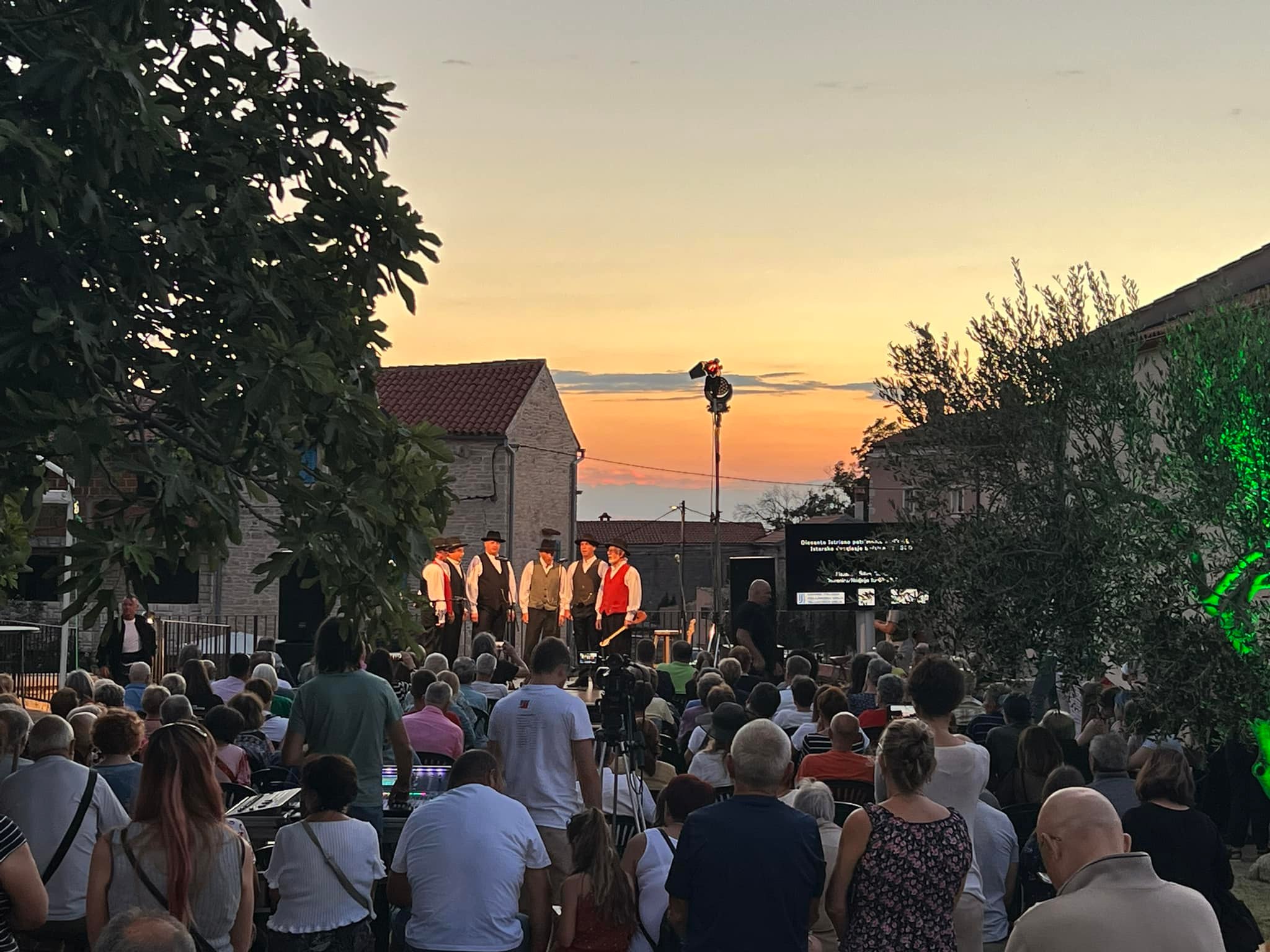
Concert in Sissano by close-interval disconti from Istria
Music has always been one of the most identifying traits of a people, it is linked to a particular culture generated in a particular region and must be protected and enhanced as a cultural heritage to be spread among present generations and passed down to future ones. The same goes for folk songs, a strong element of identity of a community. Cultural initiatives such as the one promoted by the Italian Community of Sissano are therefore welcome, which, more than aware of the importance and necessity of preserving the rich local cultural heritage and not only, has thought it a good idea to give form and substance to an event dedicated and reserved exclusively for the folk songs of Istria. We are talking about the concert “Discanto istriano patrimonio dell’Unesco”.
An educational evening
However, calling it just a concert would be profoundly reductive, both for the quantity and quality of the contents proposed. More than a simple singing performance, one of many, the event the other evening was much more. In fact, the large audience present had not only the opportunity to listen to the different Istrian descants at close intervals, but also had the opportunity to learn something more about their origins and specificities. Also present in the audience were the Councilor for Culture of the Istrian Region, Vladimir Torbica, the Mayor of Lisignano, Marko Ravnić and Marin Corva, President of the Executive Board of the Italian Union, whose support (together with that of the Office for Human Rights and National Minorities of the Republic of Croatia) was fundamental for the organization of the evening.
A documentary by Dario Marušić
The evening was officially opened with the screening of a short documentary video in which the ethnomusicologist Dario Marušić lists and explains the characteristics of the Istrian descants, some of which have unfortunately fallen into disuse, such as the “bugarisse” from Valle. The two presenters of the concert then appeared on stage: Manuela Geissa and Claudio Grbac, who immediately recalled that in 2009 the Convention for the Safeguarding of the Intangible Cultural Heritage of UNESCO included in its list the kanat, the tarankanje, the bugarenje and the pojanje from Peroj, but also the Istrian-Venetian descants such as the butunade from Rovinj, the bugarisse from Valle, the bassi from Dignano, the canti a la pera, a la longa and xota le pive from Gallesano and, of course, the mantignade and the canti xota le pive from Sissano.
From the mantignade and xota the bagpipes…
The evening then got into full swing. The first to perform could only be the hosts. Thus, the representatives of the CI of Sissano, Claudio Grbac and Gino Sverko first and Antonio Dobran and Claudio Grbac later, introduced themselves to the public with the mantignade “Se fusi Carnevale ogni giorno” and “La mare ne paricia al dixna”. Accompanied by the sound of Gino Šverko’s bagpipe, they then performed the canto xota le pive “Canto le mantignade e vado torno”.
…to the bugarenje and the canti a la longa
After the Sissanese mantignade, the all-female group “Frndalice” entertained the audience with two typical songs of the Croatian population of Ciciaria, where the traditional song is the bugarenje. The next performance saw the involvement of representatives of another Italian community, that of Gallesano. Corino Moscarda and Violante Moscarda Valente performed two songs a la longa: “Sta note jera aperto il tuo giardino” and “Chi sapa formenton polenta magna”. The tarankanje, a song widespread throughout Istria and along the entire Croatian coast, was instead presented by Zoran Karlić and Noel Šuran.
The lowlands of Dignano and the butunade of Rovinj
Afterwards, the audience was introduced to the basses of Dignano. The task fell to Livio Belci and Gloria Valle, from the Italian Community of Dignano. The concert dedicated to the Istrian discanti was also attended by the Italian Community of Rovigno, whose two representatives, Alessio Giuricin and Antonio Curto, offered the audience four butunade: “Cu i paso par da qua ei rasco ei spoudo”, “I nu vido l'ura ch'el sul vago a li base”, “A miexa pesce l'amur meio nu viene” and “A Muntalban ga stansia dui viciuoti”.
The Bugarissa of Valle
In Sissano, the audience was also met by the kantaduri from Seiane (Žejane) and the boys from the “Ivan Matetić Ronjgov” Music School, as well as Dario Marušić himself, who together with Noel Šuran sang the bugarissa from Valle “Morosa mia fa che te lu meto” and together with Goran Farkas “Izrasla je narančica”, pojanje from Peroj. After the official part of the evening, the group “Veja” from Pazin was invited on stage, entertaining the audience with a series of traditional Istrian songs reinterpreted, however, in an ethno-pop key.
Marko Mrjenovic
Source: The Voice of the People – 12/07/2022