Language
 English


Disorder. An (almost) sentimental primer.
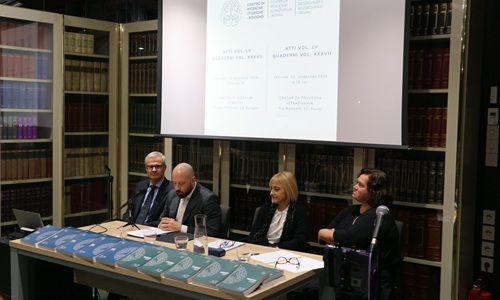
Anna Maria Mori, born in Pula, exiled in Florence, and established herself as a nationally renowned journalist in Rome, turned 90 on April 12. Her journalistic career began with the weekly Annabella , continued with Rome's Il Messaggero , and participated in the founding of la Repubblica . She also worked on radio and television, particularly with the documentaries made for RAI "Istria 1943-1993: fifty years of solitude" and "Istria, the right to memory" in 1997. These were invaluable contributions in the 1990s, when the history of Italy's eastern border was beginning to emerge in the national spotlight. The first edition of Bora . Istria, the wind of exile , co-written with Nelida Milani, a leading figure in the literature and culture of the native Italian community in Istria, also dates back to 1999. Bora brought to the attention of the general public an exchange of letters between an exile and a “remainer”, also contributing to the ongoing debate on the mutual relations between Italians of the exodus and the eastern Adriatic.
In 2006, Mori celebrated her 70th birthday with Nata in Istria , an autobiographical journey through her childhood memories and also recounting the history, culture, gastronomy, and traditions of her native land. She also celebrated her 90th birthday with the publication of Disordine. An (almost) sentimental primer for HarperCollins Italia.

What happens when chronological order gives way to the more urgent and true rhythm of memory? When memories don't line up in a row, but emerge through associations, gaps, sudden insights?
In her "(almost) sentimental primer," Anna Maria Mori entrusts the irregularity of lived experience to the alphabet, making each letter the threshold of a locked room. What emerges is a mosaic in which personal history intertwines with collective history: memories of war and peace, reflections on love, motherhood, old age, private mythologies, and small everyday wonders.
Alongside the great names of culture, cinema, and entertainment, anonymous and unforgettable figures appear: a woman who silently loves an unattainable pianist, a dog who dies of fright during an air raid, an actress trapped in a body she no longer recognizes, deformed by injections imposed to resemble herself twenty years earlier.
Each text is a poignant and very short fragment, which opens and closes like a song, and can be leafed through like a diary, while you laugh, you cry, you always recognize yourself.
One of the most authoritative journalists in our country, a key figure in the founding of La Repubblica , Anna Maria Mori signs an atypical and powerful memoir: an emotional map, chaotic and luminous, where order is only apparent and the true rhythm is the chaotic one of intuition, tenderness, irony.