Language
 English


«Favelà»: recovery and protection of the ancient dialect of Dignano
The square in front of Palazzo Bradamante in Dignano hosted the closing ceremony of the dialect literary prize. This year, the participation of third-age authors was absent.
This year, in Dignano, jo favelà la piasa. This is because the final evening of the “Favelà” Competition, organized by the local Italian Community together with the Dignanese Family, did not take place as usual in the little square behind the bell tower, but in the square, in front of Palazzo Bradamante, which is a setting that speaks for itself.
At the beginning of the evening, the president of the association, Livio Belci, the president of the Dignanese Family, Luigi Donorà, the deputy mayor of Dignano, Diriana Delcaro Hrelja and the president of the Italian Union, Maurizio Tremul, addressed those present with speeches of circumstance. Then, the heart of the evening began, with the awarding of the winners.
Five participants
This year, five authors participated in the Competition (now in its 19th edition); not many, in truth, but it is hoped that in the future things will go better. As Manuela Geissa, who hosted the evening with sympathy and skill, noted, "there was a lack of authors of the third age, the oldest, who however can give their contribution by passing on the dialect to the younger generations; it is in fact necessary to invest in young people, who by learning the dialect can give it new vigor".
Five, we said, the participants and precisely Gianna Belci, Ernesto Chiavalon, Loredana Bogliun, Germano Fioranti and Giulia Timea Fioranti. Their works were evaluated by a jury composed of Marta Banco, Paola Delton and Sandro Manzin representing the CI of Dignano, as well as Luigi Donorà, Giuliana Donorà and Massimo Delzotto representing the Dignanese Family. The Competition categories in which the authors competed were “Literature – poetry section”, “Literature – prose section”; “Translation” and “Video”.
Memories and personal thoughts
The first prize in the Poetry section was not awarded, while two second prizes were awarded ex aequo, to Gianna Belci and Ernesto Chiavalon. In Belci's absence, Manuela Geissa herself read her verses: “Cunfeidense”, “Feiurerei” and “Lontan”. Ernesto Chiavalon read his “Ancui”, “La crosola” and “La xi xeida”. “Ability to convey emotions, fears, memories through intimate poetic images in which attachment to family and birthplace appears. Fluid poetic language that makes reading enjoyable, refined mastery of dialect”, was the motivation for the Award to Gianna Belci. Chiavalon's poems, on the other hand, are “poems that induce reflection, full of personal thoughts, which are sometimes difficult to interpret. Rich in vocabulary and expressions of the ancient Dignano dialect, of which the author has a good knowledge. “Graphic uncertainty hinders the original perception of the dialect”: this is what the jury said.
Germano Fioranti won second prize in the Prose Section for “La louna”: “A well-written work that describes a cross-section of the way of speaking and expressing oneself typical of a bygone era in which the imprinting of the day was given by observing nature”.
The Translation Award was given to Loredana Bogliun, who transposed into dialect the theatrical text “Dietro a un discount”, by Roberta Dubac. Bogliun’s work was judged to be “a well-made, substantial work, which shows commitment and passion in the translation done… In its complexity, the work is impeccable”.
Finally, an honorable mention for Giulia Timea Fioranti, who participated in the “Video” category. What did the jury think? Quickly said: “The commitment of the young participant intent on expressing herself in the Boumbaro dialect is appreciable. Her participation in the category is praiseworthy.
Usually the closing ceremony of Favelà offers a musical interlude: Maestro Luigi Donorà took care of it, performing some popular songs on the piano.
Tribute to Dante
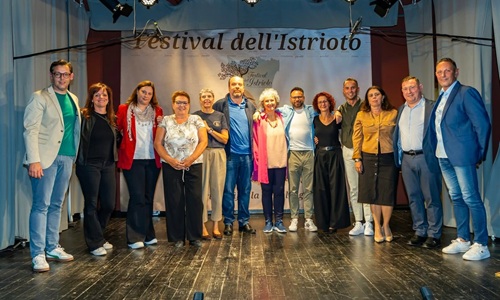
As a… tribute, the Dante sonnet “Tanto gentile e tanto onesta pare”, offered to mark the 700th anniversary of Dante Alighieri’s death. If the original gave you a headache, you should see the complexity in the translation into Boumbaro. The transposition was done by Pietro Sansa. Fabiana Laić read the two versions. And after the ritual photos, the microphones and spotlights were turned off. The XNUMXth edition of Favelà is on record.
Carla Broken – 18/08/2021
Source: The Voice of the People