Language
 English

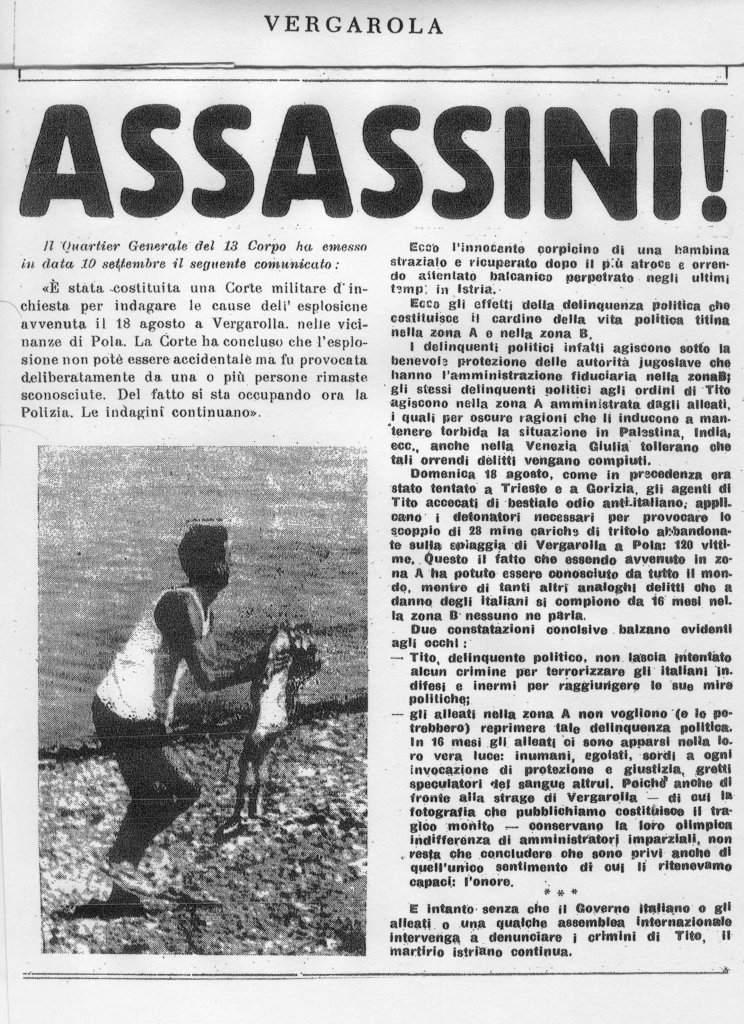
The man in the photo of the Vergarolla massacre has a name
75 years ago the explosion in Pula that killed one hundred people. Bruno Castro, a direct witness, from Canada tells for the first time the truth about the symbolic photo of the photo with the decapitated little girl.A sharp shot like a gunshot, then the end of the world: an explosion shatters the rocks on which thousands of people are enjoying the sunny Sunday in August, the pine forest erupts into a blaze, the sea turns red with blood and crazed seagulls fight over the human remains raining down from the sky. As a mushroom cloud of smoke rises from the beach, the entire city for miles around shakes, shattering shop windows and storefronts. Pola, Italy, August 18, 1946, 75 years ago today.
It was the first terrorist attack in the history of the Italian Republic and the bloodiest, bloodier than Piazza Fontana, bloodier than Bologna Station. In the massacre at Vergarolla, the beach of Pola, over one hundred people lost their lives, but only 64 of the pulverized bodies could be named; for the others, doctors will take stock by putting the pieces together and counting the limbs. A third were children.
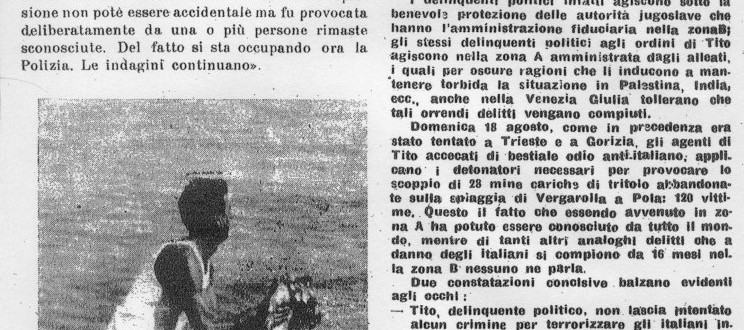
And as with every tragedy, there is also a symbolic photo for the Vergarolla massacre, which appeared in the newspapers the day after the attack: a horrified man running along the shore holding in his hands the inert body of a little girl dressed in white with her head unnaturally bent over her back. It is an image that is still indelible in the minds of the survivors, but until today it has remained without a name: who was that little girl? Who was the man who picked it up? Where was he taking her? Was she perhaps his daughter?
«I remember that precise moment, I was 14 years old», Bruno Castro, an Istrian born in Pola in 1932, tells us for the first time from Canada, «in the great confusion that followed the explosion I found myself in front of my brother-in-law Mario Angelini, he was running with his eyes wide open among the wounded and the corpses holding that little girl in his hands. I couldn't see her face because her head was hanging down her back. I only saw some black curls on her white dress. Mario continued to run and placed her on a truck that was taking away the first bodies, but in the meantime he shouted at me to run home to my mother." After 75 years, therefore, the still image comes to life again and tells us previously unpublished, chilling details about what has incredibly remained the most unknown page of our republican history. “Avvenire” has already recounted on several occasions what happened that day and the historical/political context of the Vergarolla massacre, based on historical investigations and the many eyewitnesses still alive, but the vivid account of Bruno Castro, who managed to escape from Tito's Yugoslavia only in 1963, sheds new light and confirms many elements.
«That day in Pula, important swimming competitions were taking place at the Pietas Julia Patriotic Club, which is why thousands of Polesine people crowded the beach and entire families, after watching the morning competitions, waited for the afternoon ones, eating and resting under the pine forest», a few steps away from the 28 large war devices stored for many months on the beach and completely harmless as they had been defused by the bomb disposal experts under the control of the Anglo-Americans. «In the morning I had run the 400 meters and now my friends and I were playing “handcuffs”, you threw five pebbles into the air and had to catch them all together in the air. It was then that we heard the first shot."
“We children always played astride those mines and torpedo heads, our mothers hung out their costumes to dry on them,” Claudio Bronzin, then 12 years old, had already told us. He was saved that day but lost his family and many friends. He too, like Bruno Castro, had heard that "gunshot" before the inferno, there are many witnesses who tell this story. And it was Scotland Yard that immediately discovered that the “shot” was in reality nothing more than the trigger for the malicious attack, the timed detonator set to massacre Italians: Yugoslav circles immediately tried to talk about an “accident”, but their Anglo-American allies knew well that the 28 devices as they were could never have exploded, they had been reactivated for that day. The Pietas Julia sporting event was in fact patriotic, the war had long since ended everywhere but the very Italian city of Pola was still waiting with bated breath to know its fate: in Paris in those days the victorious powers were redrawing the Adriatic borders and the people of Pola thus intended to reiterate in the eyes of the world their desperate desire to remain Italian and not be abandoned to the expansionist aims of the Yugoslav Marshal Tito.
«I have a clear memory of that first shot – continues Bruno Castro in his house in Toronto, on the walls are wooden bas-reliefs with views of his Pula, the Roman Arena, the Arch of the Sergi, the Temple of Augustus –, immediately after a child screamed and I saw many people running towards him thinking he had been hit. But just as they were going in that direction, everything exploded. I ran away, returned only after ten minutes and saw that the pine forest was on fire. There were adults running with the wounded towards English trucks. It was there that I met my sister Lucilla's husband, who was in Vergarolla as a swimming coach and was a volunteer in the fire department, in his hands he had the headless baby. There was great confusion, human remains everywhere, the red waves and those seagulls… The next day Lucilla went into emergency labor after discovering that among the dead was her best friend. Everyone in Vergarolla has lost someone dear to us, entire families have disappeared."
Only that day did it become clear to the people of Pula that Tito's communist regime would never give in to the rule of self-determination of peoples and that remaining in Pula would be impossible. Vergarolla can only be understood well if contextualised in a post-war period when in Istria there was still war, with Tito's roundups and concentration camps still very active, and with an escalation of violent anti-Italian actions that prepared the way for the worst: only two months earlier pro-Yugoslav militants had even stopped the Giro d'Italia and shot at the civil police, while the previous Sunday another bomb had fortunately misfired on the beach in Trieste during a rowing race. From the London archives (which still have much to reveal) a document from the time attests to the "expressed will of the Yugoslavs to boycott any Italian event, including sporting ones": Pola must empty itself and become Slavic at all costs.
«And then the city was truly emptied with the great exodus of '47 – continues Bruno Castro –. My parents were among the few who decided to stay because my father was a convinced communist, he had his ideas… But life became impossible, there was no freedom. Like everyone else, I chose to leave and remain Italian, but the regime refused me the option with the excuse that our family was of “Croatian” origins. Obviously the surname Castro says something completely different, the truth is that having members of the party in the family would have been a disgrace for the regime if we had left. So in the 50s, with some friends, I tried to escape Yugoslavia by sea, but someone betrayed us. Many tried to escape by boat at night but disappeared into thin air… I even had to be a soldier under Tito – he says, showing the photo album that portrays him among many young people in sports uniform around the visiting dictator –. Nobody spoke about politics, there was so much fear. Even Mario has always remained silent, having died in Pola 15 years ago without speaking about Vergarolla or about when, as a firefighter, he descended into the Foibe in search of his brother, who was never found. It was necessary to forget and live". He also ended up in prison, the young Bruno, now an electromechanic in the shipyards of Pola, accused of sabotage for a normal failure of the engines of the boat that carried the officers, "it's already good that they didn't send me to Goli Otok", the most infernal of the gulags on the Goli Island. «Finally in 1963, with my wife Maria Ghersini from Dignano, who is 89 years old like me, we managed to get permission to leave and today in Canada we are part of a large community of Julian-Dalmatians who fled down here but always remained Istrian».
With Maria, with her daughters Astrid and Carin, and even with her 26-year-old granddaughter Alina, she still speaks the Istrian-Venetian dialect. «We return to Pula every summer – smiles Astrid – we have Istria in our blood. I was born in Latina in the refugee camp, immediately after my parents fled from Pula and before leaving for Toronto, but I will always be Istrian. Above all, I feel a great responsibility to carry on our history, because I know well what our parents had to suffer for freedom and to remain Italian. It is not possible that Italy knows nothing of what happened in Vergarolla, why remain silent any longer? "While I lived in Pola we were forced into mutual silence - explains his father -. I saw the original photo of my brother-in-law in the newspapers in 1946, but at home everyone was silent. Then once in Canada what was the point of bringing out this unknown story? And with whom? But to tell the truth, you in Italy still struggle to talk about these things today: has any prime minister ever gone to Vergarolla on August 18 to lay a flower? Do Italians know anything about it? A year ago Astrid found the pages of Avvenire on Vergarolla on the web and the photo of her uncle Mario with the baby in his arms “and only then did we spend the evening as a family talking about that frame. Even my cousins, Mario's children who still live in Pula, now Croatia, were shocked to recognize their father in that photo. He had never told them anything either."
Vergarolla is the event that started the Cold War at an international level and the dress rehearsal for the massacres in Italy in the decades to follow. Certainly a fact that should be included in contemporary history books. But Tito, a communist dictator but an adversary of Stalin, had to be appeased, so the West, including Italy, turned a blind eye and “forgot”. Even today, in Pula Cathedral, next to the memorial stone commemorating the victims, exiles and those who remained will gather together after 75 years to pray for their loved ones, but without a single sign of remembrance from their nearby homeland.Lucia Bellaspiga – 18/08/2021 Source: occur