Language
 English

The Cultural Heritage of the Serenissima on Display in Gorizia, Rijeka, and Lussino
Three cities, three exhibitions to showcase and promote a unique cultural heritage. From October 13 to November 4, 2026, Gorizia, Rijeka, and Lošinj will host the exhibitions created as part of the project "Serenissima Cultural Heritage from Veneto to Istria, in Dalmatia, Kvarner, and Venezia Giulia." The exhibitions—following the 2024 exhibitions featuring works by schools in Venice, Vicenza, Treviso, Rovinj, and Pula —represent the culmination of the second phase of a cross-border project involving students, teachers, school administrators, historians, researchers, Italian communities, associations, and universities. This collaborative effort explored the traces left by the Republic of Venice over the centuries, connecting history, architecture, art, gastronomy, ethnology, religion, crafts, and popular traditions. The project, supported by the Veneto Region pursuant to Regional Law no. 39/2019 and led by ENGIM Veneto, interprets the Serenissima not only as a reality belonging to the past, but as a living European cultural heritage, capable of uniting territories, generations, and communities on both shores of the Adriatic.
School twinning agreements signed in Venice in 2024 and in Rijeka in 2025
The new exhibitions complete an educational and cultural journey organized in two phases: the first Twinning Agreement signed in Venice at Palazzo Ferro Fini on October 8, 2024, at the headquarters of the Veneto Regional Council , and the second Twinning Agreement signed in Rijeka at Palazzo Modello on May 6, 2025, at the headquarters of the Italian Union and the Italian Community . The documents commit the schools to cooperate to promote the Serenissima as a shared cultural heritage, highlighting the historical elements that have contributed to the prosperity of both shores of the Adriatic and directly involving students and teachers. The twinning agreement recalls the European values of freedom, democracy, peace, social equality, respect for human rights, and the protection of linguistic minorities. It also emphasizes the importance of intercultural dialogue between Italy and Croatia and the creation of new growth opportunities for young people. A key reference is the European Faro Convention, ratified by both Italy and Croatia. The Convention recognizes the right to cultural heritage as part of everyone's right to participate in cultural life. From this perspective, heritage is a resource to be known, experienced, and shared. Communities, and especially younger generations, become protagonists in its valorization, contributing to strengthening democracy, European coexistence, and quality of life.

Gorizia and border traditions
The first exhibition will open on Tuesday, October 13th at 11:00 a.m. at the ISISS D'Annunzio Fabiani in Gorizia and will remain open until October 21st. The students from the 4ATT class of the Tourism Technical School and the 3ALS class of the Scientific High School, coordinated by the teachers and the Headmaster, worked on the exhibition content. The research explored the relationship between Gorizia and the Venetian world through various fields, from history to architecture, with a particular focus on gastronomy. Among the topics explored was "bacalà alla cappuccina," which has become a signature dish of "mangiar magro" (lean eating) and is popular in numerous Friulian convents. Another research project focused on the Gorizia Carnival, where the students identified traces of Venetian influence in the traditions of a city and region historically located at the crossroads of different cultures. The work thus restores the image of Gorizia as a meeting place, where local customs, Venetian influences, and Central European identities have built an original and plural heritage over time.
Fiume and the Serenissima in Kvarner
The second exhibition will open on Wednesday, October 21st at 11:00 a.m. at the Italian High School in Rijeka, where it will remain open until October 28th. The principal, teachers, and students from the mathematics-science, linguistics, and hotel and tourism programs have put in exemplary work studying the Venetian Republic's presence and influence in Kvarner. Research has reconstructed the islands' annexation during the reign of Doge Ottone Orseolo, the role of the Frangipani lineage, and the material connection between the Kvarner forests and Venice, whose foundations were also built with timber from the eastern Adriatic. Special attention was given to the 1483 Glagolitic Missal, one of the oldest books printed in the Croatian language, considered a testament to the cultural revolution brought about by printing and the circulation of languages, knowledge, and cultures in the Adriatic region. The students also explored the participation of the Veglia galley in the Battle of Lepanto and the history of the Venetian House in Rijeka, a still-visible architectural symbol of the city's relationship with Venetian culture. The various contributions form a narrative in which the sea does not separate, but connects: a trade route traversed over the centuries by people, boats, wood, books, techniques, goods, and ideas.
Cres and Lussino, a long life together
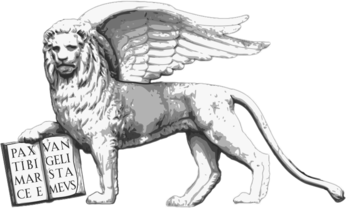
The third exhibition will open on Wednesday, October 28th at 17:30 PM at the Italian Community of Mali Lošinj and will be open until November 4th. In collaboration with the Italian Community, a qualified group of Lošinj scholars, composed of Julijano Sokolić, Ileana Brčić, and Giovanna Jerolimić Toić, with photographic support from Ivan Brčić, has worked on the exhibition. The experts have traced the Venetian Republic's journey on the islands of Cres and Lošinj, recounting a shared life over the centuries and a relationship that encompassed community organization, the economy, culture, and the landscape. Among the most significant testimonies are the winged lions of St. Mark in Osor, symbols of a historical bond that is also reflected in the architecture and daily life of the islands. The research explored the archipelago's strategic and economic role, local culture and architecture, food, work and ancient crafts, religion, and festivals. What emerges is a heritage comprised not only of monuments and documents, but also of customs, knowledge, social practices, and family memories passed down from generation to generation.
The scientific contribution of the University of Zadar
The Department of Italian Studies at the University of Zadar, the project's scientific partner, provided a significant contribution through the work coordinated by its director, Professor Ana Bukvić, author of the final scientific report. The Department offered its expertise in literary, linguistic, and cultural studies related to the Adriatic region, conducting exploratory and methodological monitoring. The study examined the main trends in contemporary research on the heritage of the Serenissima, noting that scholarly attention has focused primarily on historical, artistic, monumental, and archival aspects. The University of Zadar's contribution also highlighted the still largely unexplored potential of literary and linguistic studies, identifying several priority areas: the systematic exploration of literary sources, their scientific mapping, and the development of a stable network of cooperation between universities and research centers. Among the hypotheses formulated were the establishment of an Adriatic scientific network and the organization of an "Adriatic Encounter" for scholars. International academic cooperation is thus identified as an essential tool for deepening understanding of cultural relations between the two shores and developing future joint projects.
A network between schools, communities and institutions
The project is directed by the ENGIM Veneto Foundation, inspired by the charisma of Saint Leonardo Murialdo, and enjoys the patronage of the Italian Union and the Honorary Consulate of the Republic of Croatia in Veneto. The network of partners includes the University of Zadar, the Vittorio Cini Archive Foundation of Venice, the ANVGD – Provincial Committee of Venice, the Italian High School of Rijeka, the ISISS D'Annunzio Fabiani of Gorizia, the Italian Communities of Rijeka and Mali Lošinj, the Marinelli Fonte Technical Institute of Venice, in collaboration with the CFP CIF of Venice and the CFP Turazza of Treviso, the "Antonio Borme" Italian High School of Rovinj, the "Dante Alighieri" Italian High School of Pula, and the "Pino Budicin" Italian Communities of Pula and Rovinj. The project benefits from the collaboration of the Consular Attaché of Zadar. Author and General Coordinator: Vittorio Baroni.
EXHIBITION PROGRAM
GORIZIA
- ISISS D'Annunzio Fabiani
- Inauguration: October 13, 2026, 11:00 PM
- Opening hours: October 13st to 21th
RIVER
- Italian High School of Fiume
- Inauguration: October 21, 2026, 11:00 PM
- Opening hours: October 21st to 28th
LUSSINO
- Community of Italians of Lussinpiccolo
- Inauguration: October 28, 2026, 17:30 PM
- Opening hours: October 28th to November 4th
Sponsorship has been requested from the interested municipalities and diplomatic authorities. Admission to the exhibitions is free, with the option of obtaining all materials in the file free of charge.
Source: SERENISSIMA CULTURAL HERITAGE from Veneto to Istria, Dalmatia, Kvarner and Venezia Giulia