Language
 English

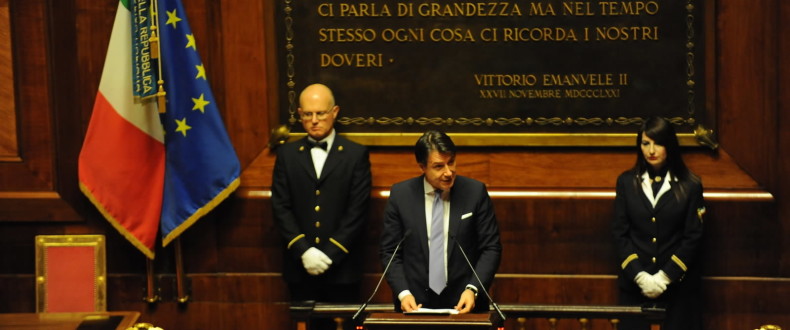
President Conte speaks at the celebration of Remembrance Day
On Monday 10 February, the Prime Minister, Giuseppe Conte, spoke in the Senate at the celebration of the “Day of Remembrance” in memory of all the victims of the foibe.
President Alberti Casellati, President Fico, Minister Azzolina, Authorities, gracious Guests, this intense celebration takes place here today, today, in this Chamber, where sixteen years ago the institution of the “Day of Remembrance” was consecrated – it was recalled – by Parliament, with a very large majority.
Since then, every year, we celebrate the memory of a national and European tragedy, consumed in those splendid, tormented lands of the eastern border, where – as the historian of Istrian origin Ernesto Sestan wrote in 1947 – those exasperated nationalisms, those oppressive totalitarianisms that stained twentieth-century Europe with ferocious colors, clashed.
It is not only the number of those who lost their lives, especially between the autumn of 1943 and the spring of 1945, that shocks us and imposes on us the moral duty to remember. The ways in which the fates of so many Italians were decided were brutal: summary executions, imprisonment in detention camps, living and dead men thrown into the depths of the Foibe, swallowed up - for many, too many years - by oblivion and silence.
The territory of Istria, Dalmatia and Venezia Giulia, places already tormented by the horrors of the previous years, experienced a further wave of violence – ideological, social, ethnic – exercised indiscriminately on those Italians who escaped extermination, even people totally unrelated to any connection with the fascist regime.
The dramatic exodus towards Italy began: towns and cities were depopulated of the centuries-old Italian presence, languages, dialects and a millenary culture dating back to the Roman settlements and consolidated with the Republic of Venice disappeared; family, social and economic networks were dismantled, history, diversity, pluralism, coexistence were exiled, on which the civilization of those places had been forged over the centuries.
Because of these acts of persecution, approximately two hundred and fifty thousand refugees, returning to Italy in dramatic situations, experienced new poverty and deprivation, the difficulty of integrating into the national fabric, the lack of compensation, but above all the pain of the exiles, exacerbated by the curtain of silence that fell on that tragedy and by the lack of public recognition of the injustice suffered.
Today we are here to heal the wound inflicted on those people and their descendants, to ask for forgiveness once again for the oblivion that has swallowed up this national disaster for decades, to which contemporaries – out of superficiality or calculation, as President Mattarella had occasion to underline – have not given importance.
Today we are here to remember and to reconnect the thread of a broken memory, but above all to preserve it and pass it on to new generations.
In fact, it is not possible to build a shared and collective memory of the past without the contribution of the various components of society.
The path that led to the institution of the Day of Remembrance was long, it was tiring, the fruit of the self-denial with which the associations of exiles, their descendants, writers, historians and intellectuals have raised their voices against indifference for years.
I recall here the poignant, beautiful literary pages of Nelida Milani, whom we are about to listen to, of Enzo Bettiza, of Guido Miglia, of Fulvio Tomizza, of Lina Galli, of Claudio Magris, and of many others who have claimed their right to testify. Bettiza stated, "for an exile, as I was, the word was the only way to defend identity".
This path is also the fruit of a process of emergence of national consciousness, which involved intellectuals and politicians, engaged in a more mature, more conscious reflection on those tragic events, in all their depth and historical complexity.
It is a sign of great maturity for a people to address the understanding of facts and memories, even conflicting ones, of their past, through a serious, rigorous public debate, free from exploitation, in which history, memory and identity are strictly connected.
It is impossible not to remember here, in this Senate Chamber, that the 2004 law was the outcome of the confrontation between opposing political forces, which at the time put aside ideological preclusions, differences in values, even strongly asserted ones, to prevent that very painful event from continuing to be a cause of conflict and division, and so that on the contrary it became a factor of unity for the Italian people.
Today the national community considers this tragic memory as a constitutive heritage of its national identity.
The ethics of responsibility calls us all to keep that memory alive, also to contain, to condemn any form or episode, however isolated, of reductionism or denialism or any attempt at vile political exploitation.
In 2004, when the Italian Parliament approved the law establishing the Day of Remembrance, Slovenia joined the European Union.
The idea of European integration was born – we can say – from the ruins of the Second World War, to unite peoples and states that had fought fiercely for the conquest of borders, and then expanded, through successive accessions, especially towards the eastern quadrant, to heal the deep wounds inflicted by national hatreds.
I am addressing especially the young people, you young people, you can travel today in those eastern lands of Slovenia and Croatia. Travel for study, work, even fun, without having to cross borders anymore.
In those lands, where there were curtains and where there were – even in such a recent past – ethnic wars, today there is a common space for integration, exchange, even the promotion of rights.
But it is important not to forget, never to underestimate the risk of new nationalisms, new hatreds, divisions, new oblivions.
“I will never forget that night…, I will never forget that smoke… I will never forget those flames… I will never forget that silence” wrote Elie Wiesel, witness to indelible crimes against humanity.
Here, the Day of Remembrance serves to repeat that expressive formula, that “I will never forget” so that it can resonate in our minds, in our hearts, so as to be certain that it passes definitively into our national history, into the history of Europe, into the history of each of us.