Language
 English

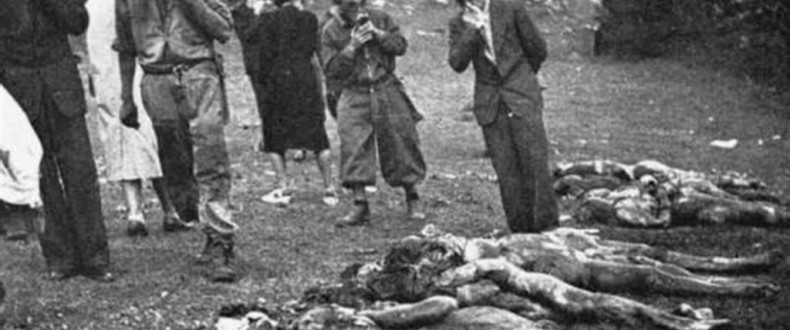
The trial on the foibe was blocked
Sergio Dini, former head of the military prosecutor's office in Padua: "We had identified those responsible but the investigation was transferred from the Supreme Court and disappeared. The commander of the Borovnica concentration camp? He received an Italian pension until his death"
by Andrea Pasqualetti – The Corriere della Sera – 11/02/2021
Source: History Online
Doctor Sergio Dini, when you were military prosecutor of Padua you investigated the foibe. It was the early 2000s. What did you discover?
«First of all, we had identified the commander of the Slovenian partisans of the IX Corpus, the partisan unit of Tito's army that between May and June 1945 had occupied Gorizia, ordering the arrest and indiscriminate killing of Italians. He had also been informed of our investigation for "continued violence through murder against private enemies". There were the names of about sixty victims but in reality there were many more, because in that month and a half in that area hundreds of people disappeared, both military prisoners and civilians from Gorizia. People of whom nothing more was heard, presumably having ended up in the various sinkholes of the Carso. Then we had identified two of those responsible for the massacre of the 12 carabinieri, also committed by the IX Slovenian Corpus at Malga Bala, near Tarvisio. The Carabinieri had been taken prisoner in March 1944. A barbaric massacre: they were forced to drink caustic soda and black salt, they were tied with wire around their wrists, they were tied up and killed with pickaxes. And then there was the investigation into the commander of the Borovnica concentration camp in Slovenia, who had also been an Italian citizen and had received a pension from Italy until his death. From May to December 1945 he had dozens of Italians die of beatings and hardship, especially bersaglieri. We also found evidence of the shooting of ten Italian military prisoners in the camp…».
How did these investigations end?
"The first, the one on the hundreds of missing persons and the sixty victims identified, was transferred to Gorizia by the Attorney General of the Court of Cassation who accepted an objection of incompetence raised by the commander's defense. An extravagant provision: they said that the facts were not within the jurisdiction of the military prosecutor because the causes of the murders were unrelated to the war, linked more to political persecution and ethnic hatred. As if ethnic hatred and political oppression had never been causes of wars".
But what reason would the Supreme Court's prosecution have had to transfer an investigation, if not a jurisdictional one?
"I don't know. What is certain is that the investigation was closed and only the trial was left to be held. There would have been a public hearing that could perhaps have been uncomfortable. The climate was one of silence and downplaying..."
Do you see a political will?
"That ruling by the Supreme Court was truly disconcerting for me. We're talking about the year 2003 and at that time there wasn't much sensitivity about the tragedy of the foibe. There was little talk about it and anyone who did was considered a neo-fascist. There was still a lot of disinterest and underestimation. That is, while the trials of German war criminals, after Priebke, garnered a lot of consensus and great visibility, these definitely didn't. And keep in mind that I investigated on both fronts. The denunciation of the cover-up of German war crimes was made by Padua. I had filed a complaint with the Council of Military Judiciary and from there the case of the so-called closet of shame exploded. I think I was the only magistrate to have made a public denunciation of the cover-up of those files, which was also aberrant. As a military prosecutor we then investigated the American massacres in Sicily, we denounced the Italian war crimes in Greece. In short, we didn't work unilaterally."
Now the climate is different…
"Yes, investigating the foibe today would be different. A question of sensitivity."
What did the Gorizia prosecutor's office do?
"After some time he discovered that one of those magistrates had a relative who was thrown into a sinkhole and therefore was an injured party. Incompatible. Since he could not deal with it, the case was transferred to Bologna and from there nothing more was heard."
The other two investigations?
"I had to shelve the investigation into the massacre of the Carabinieri because there was no collaboration from the Slovenian authorities in identifying the individuals. In the end we were unable to reconstruct the organizational chart of the partisan group responsible for the events. The investigation into Borovnica was instead shelved due to the death of the perpetrator, the commander."
Has no one investigated the foibe anymore?
"Yes, these are unpunished crimes. No trial has ever been held. Partly because of the bad will of the investigating bodies and partly because in the few cases in which they were tried there was neither international collaboration, nor political support, nor judicial support. This confirms the fact that when it comes to war there is only one type of justice, this one unilateral: that of the victors towards the vanquished. The Germans lost the war and were tried, the Slavs won it and remained unpunished, despite the horror of the foibe."