Language
 English

The Sense of Homeland in the Great War
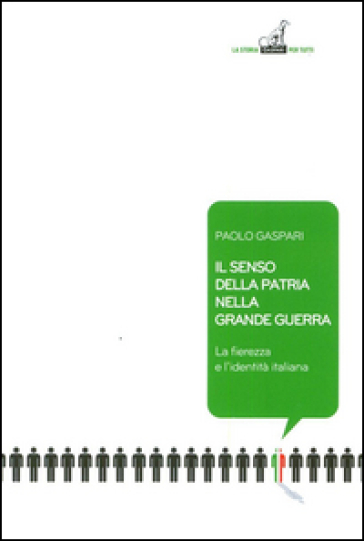
The centenary of the First World War has oscillated between two extremes: on the one hand, a patriotic and rhetorical revisitation of the battles; on the other, a pacifist and do-gooder denigration of rainbow flags. In the middle, a myriad of associations, small publishers, and scholars of the subject found themselves, amidst substantial institutional apathy, formally due to spending reviews (i.e., further cuts to culture). They have worked to give broader meaning to this anniversary, for which they had been preparing for years. Among these is Paolo Gaspari, a Friulian publisher and author of valuable essays and research on the Great War, which saw some of its most crucial phases in his region. His essay, " The Sense of the Homeland in the Great War: Italian Pride and Identity ," published in 2014, represented and continues to represent a significant contribution to the debate on the meaning and significance of that monumental conflict in the construction of the Italian national consciousness.
The author/editor first of all captures the collective dimension of this phenomenon, in antithesis with two other moments proclaimed as fundamental in the formation of the Italians, namely the Risorgimento and the Resistance, which in reality saw the active participation of minority fringes and took on the characteristics of civil war. The mass mobilization from the beginning and the so-called "sacred union" realized not at the moment of entry into the war (as happened in the rest of Europe in the terrible summer of 1914) but after the catastrophe of Caporetto, are represented as the decisive steps in bringing students from the big cities, farmers from the countryside, factory workers and career soldiers to become Italian citizen soldiers. Following a detailed parallel with other contemporary experiences, the path of acquisition of citizenship and civil rights is highlighted not only through the extension of suffrage, but also and above all in the enlistment and in the consequent ability to amalgamate people from very different socio-cultural backgrounds into a cohesive and compact force.
A valid expert in military history (the lack of teaching of which is acutely criticized), Gaspari explains well to the reader the uselessness of the eleven battles of the Isonzo, both from a military point of view and from the side of the formation of a national conscience in the thousands of infantrymen thrown to the assault of impregnable positions. Already in these first two and a half years of war, however, the first signs of the formation of an esprit de corps and a sense of sacrifice for the Fatherland were evident, whose defense on the Piave line would have meant also defending the rights that would have been guaranteed within it. The Royal Army no longer appeared as the ruthless Savoyard instrument that had devastated the southern countryside in order to eradicate brigandage and cannon-fired the demonstrators of Milan; within it a camaraderie and a sense of body were beginning to emerge, witnessed by a flood of medals and decorations, from whose motivations emerge absolutely extraordinary episodes of heroism and self-denial. : Clearly there was not an idyllic harmony between officers and subordinates everywhere, nor even between comrades, however the popular masses, who had remained on the margins of the national unification process and had recently acquired a party identity more easily than a patriotic one (Catholics in the countryside, socialists in the factories), recorded lower rates of desertion and mutiny than other armies. This development demonstrated the correctness of the vision of the conflict as a potentially revolutionary moment that presided over the democratic interventionism of Mazzinian extraction and that of revolutionary trade unionists such as Filippo Corridoni and Alceste De Ambris. The Socialist Party proved to be completely detached from these dynamics, and at the end of the war it also proved incapable of embodying the demands of the veterans who were calling for agrarian reform and greater involvement in public life (Benito Mussolini would have called it "trincerocracy", having proved much more astute in intercepting such moods).
The monuments to the fallen and the lists of fellow citizens who died in battle, carved next to the famous Bollettino della Vittoria, present in all the municipalities of the peninsula, prove the totalitarian involvement of Italian society, denote a unifying interclass capacity and still create a sense of belonging today. In his agile booklet (62 pages), the passionate author does not refrain, finally, from highlighting the faults of the Italian ruling and teaching classes in having removed this very important unifying myth from the conscience of the new generations, simplistically dismissing the Great War as the antecedent of the twenty years of fascism and instead dwelling in a self-destructive manner on the military defeats of the unification period. A people unites and recognizes itself in victories and the one achieved on November 4, 1918 is a point of reference to be reevaluated not only in a patriotic sense, but also in a social sense, with reference to the hopes for reforms and change that arose then and are still relevant today in many ways.
Lorenzo Salimbeni
The Sense of Homeland in the Great War