Language
 English

On holiday in Vrsar: from the balcony above my house
I am sitting on a comfortable armchair on a balcony in Vrsar, above what is, was, my home.
I am, perhaps, ten meters from my parents' bedroom, the room where I was born.
My house is a few meters away from me, never been so far away.
It is silent. Can you say that a house is alone? The impression I get, looking at it, is solitude, a great, immense, desolate solitude.
The laughter, the games, the shouts of us children, the voices of the adults that overlapped, the people who entered and exited the "shop" are only memories, mine, the ones that have followed me - haunt me? - all my life.
I have been in Orsera for a few days but the “shutters” are always closed, at any time. There is no sign of life; and yet, in that house, someone lives there, I know him, or rather, I know her.
In the last few years I have entered my house a few times: an unspeakable sadness.
The kitchen is “almost” the same as it was seventy years ago; we had just had it re-tiled, it was dazzlingly white. The whiteness has faded, it has become an old kitchen, lifeless. Entering it, you immediately feel a sense of abandonment.
The kitchen, the life of grandmother Anna “the farmer”, always full of a thousand things to do: serving customers in the shop, cooking those exquisite dishes that she always prepared for us, doing it even at night, if she didn’t have time to do it during the day, attentive to everything, to every detail, so that everything worked perfectly.
During my six years -1947/1948 with the great thought for me, to take care of, no, to take care of with love, so much, so as not to make me feel the lack of mom and dad. With the question in mind: will they let her return to Trieste, this little girl of mine? When? I remained in Orsera, hostage of the Titoites, for a year, with her. Unforgettable, the memory of her arms that held me, lovingly.
The balcony where I am was built above our courtyard, at the back, where, once upon a time, there was the shed, Uncle Bepi's kingdom.
Under the shed was the uncle's workshop and the dark green “Magirus” used for transporting goods to be sold in the shop and for the road haulage service was parked there.
That truck is still remembered in Orsera and it is still remembered by the exiled Orsaresi who, every now and then, I meet. It was the cross and delight of the uncle, passionate about mechanics and constantly intent on keeping it in perfect conditions.
It is evening, one of many, at dusk, after September 1943, XNUMX.
There is a war, many people have started to disappear and have never returned.
Mom and grandma are worried when they don't see dad and uncle coming back. Grandma goes to the big brown door, the one that leads to the courtyard, she opens it wide, almost as if to hurry her children's return; she kneels down, bends down until her ear touches the ground: she tries to pick up the vibrations of the ground caused by the arriving truck.
Since that September 8th she has always done it. I see her bent over to perceive the slightest jolt of the ground, tense to hear any noise. Only that gesture of hers made one understand the anxiety, the fear that tormented her and that, with words, she never expressed.
They always came back, dad and uncle, only at the end of November 1946 dad didn't come home for forty days, locked up in the prison in Parenzo.
I am five six years old. I am in the courtyard. Here too there is life, there is movement.
Up above, far from the house, there is a large space enclosed by a wire mesh for the chickens and the rooster. They scratch around peacefully. Further away are the dindi. Every now and then grandma would let them roam free in the yard. I was fascinated by them. So ugly. And when they would do a cartwheel and chase me, fast, how scary!
They got sick easily. Grandma, then, prepared a medicinal mixture, grabbed them, opened their beaks wide and “stuffed” that paste down their throats. To make sure it was swallowed, with her hand, she pushed down, along the neck, that “miraculous” food that served to prevent ailments.
From the balcony I hear, very close, the barking of a dog. Is it Bobi? Our old Bobi? He too has remained: in Trieste, in an apartment with eight people, there could not be room for him too. He too, a victim.
I don't see the white laundry hanging out to dry fluttering, moved by the breeze that is blowing at this moment.
That too is missing, and the faint sound of the sheets blowing in the wind is missing. The flight of the pigeons is missing, their cooing: there were so many of them.
There is, all around, an unnatural silence. Maybe it is the great heat that keeps people at the beach or locked in their homes.
I look out and see the big fig tree, which I was very fond of, bastardized. They didn't know, didn't want, couldn't keep it as we left it, a tireless producer of sweet flowers. It's all spread out in low bushes that even climb up the high wall that surrounds the courtyard.
The warehouse door is closed. The warehouse is no longer of any use. There is no longer a shop, there is nothing left to store.
That very high, vaulted door, which, back then, opened and closed countless times a day is always closed. The short road that allowed the “Crasti truck” to enter and exit has become a short, very narrow street surrounded by oleanders: the flowering parking lot of some cars.
I search, I search for the great sisole tree that generously gave its shade to the cistern below. It is no longer there. Its exquisite fruits can no longer be enjoyed.
The large old rose bush in front of Mom and Dad's bedroom has disappeared. You would walk through the little door that opened onto the courtyard and be inundated with the intense, enveloping scent of those roses of a dull old pink color. I have never smelled the same again.
The cistern has become a storage room. It was useless. The aqueduct has been in Orsera for many years.
I look further, over the roofs and I see some new houses sprouting, without history. Or rather, there is a history. They were built for refugees fleeing the war in Yugoslavia.
Before, on that little hill of Brustolade, I went to pick white violets, pale purple, dark purple. It was all covered with violets.
At its feet, instead of a large field of Spanish grass, there is now a soccer field. In that enormous field of alfalfa, only once, I went to play dragging my little friends behind me, trampling it and getting a big, well-deserved slap from grandma Anna.
I had disobeyed, I had caused damage because the cows and mules did not eat the trampled and cut down grass.
Now the scent of violets does not spread in the air and the tall Spanish grass does not sway in the wind.
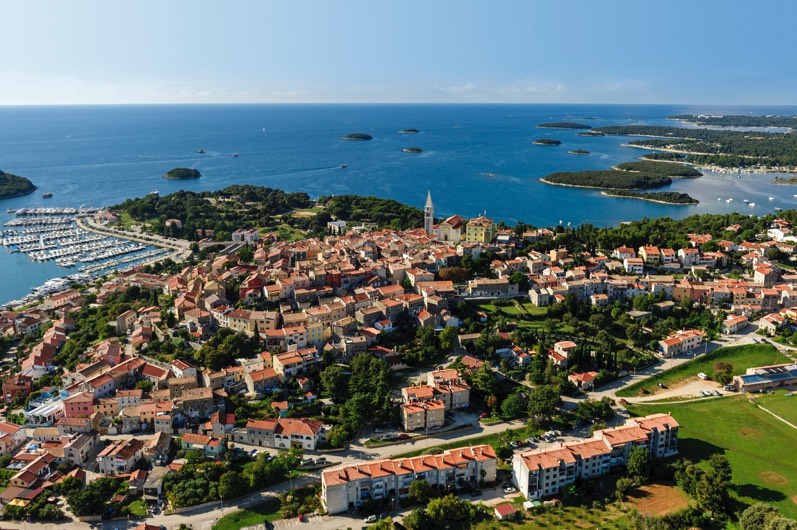
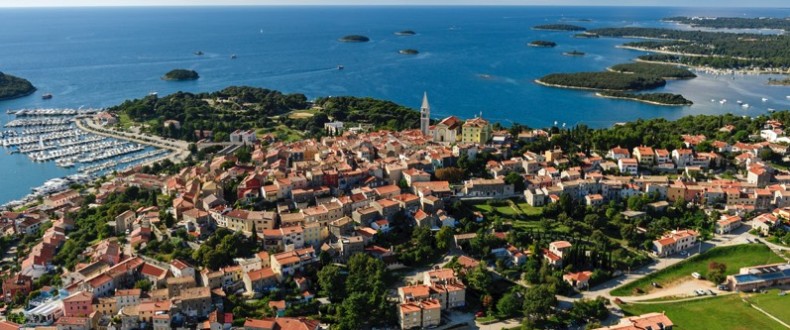
I look around. Everything seems small to me. Yet, looking at an old postcard of Vrsar seen from above, I realize that the court was really big.
They halved the shed, they built a house on the edge of that courtyard of mine. The more I look around, the more I am gripped by anguish. Always, at any time of the day it is empty, lonely.
There isn't even the old "gnagna" who swept it and kept it clean, scolding me if I bothered her when she worked there.
Now we are not the only ones, the old inhabitants of the big house; there are no more animated discussions, no more exclamations of joy, of anger, their coming and going. Even the animals that with their cooing, their cackling, their barking, their meowing filled the air around with sounds have disappeared.
I wonder how many, like me, when they look back at their homes, their gardens, everything that once belonged to them, everything they loved, that they still love, how much desolation, how much dismay, how much despair they feel?
“I’m going home,” I always say, returning to Vrsar. But which home am I going to, if it lacks a soul?
Blessed Don Bonifacio, addressing his boys of Crasizza, had asked: “Do you remember that you have a soul?”
We could ask ourselves the same question, even today.
We, Exiles, who, precisely because we had a soul, had the strength, the courage, the firm, unshakable will to leave or flee, as my family did, all convinced, certain that what we were was far more important than what we had.
Anna Maria Crasti
Source: February 10 Committee