Military violence and massacres occurred in the context of a complex situation in the Balkan region.
The recent eightieth anniversary of the beginning of Italian and German military operations in the Kingdom of Yugoslavia (6 April 1941) has prompted some historians – first and foremost Raoul Pupo and Marina Rossi – to take up the issue again and to give a reading that – in our humble opinion – does not render an exhaustive service to the cause of History. When referring to violence and massacres, it is necessary to present the historical truth to public opinion in its proper context, explaining the why. In every decision, in every action there is a why. Be careful: the explanation of the why does not justify or absolve any violence or massacre, obviously, but the why must also be presented, to draw a truly complete picture of the historical event. What is missing, in our opinion, in the reconstruction that, on these pages, a few days ago, Marina Rossi presented with her article and Raoul Pupo with his interview? The why is missing. The Italians behaved badly in Yugoslavia, they were bad: shame on them! Does anyone care to know why? In what context did the soldiers and officers of the Italian armed forces deployed in Yugoslavia from 6 April 1941 until the end of the Second World War find themselves operating? We believe it is useful to give our own reading of the story, adding some whys, without contesting anything that has been said about the responsibilities of the German and Italian forces during the invasion and partition of Yugoslavia in 1941. This, we repeat, is not to justify or attenuate what happened, but to allow public opinion interested in that chapter of history to make an effort to identify with it, if necessary. The topic is extremely complex, as complex as the mosaic that makes up the Balkan region is articulated and would deserve a very interesting conference to be organized here in Trieste in the future together with historians from the countries of the former Yugoslavia.
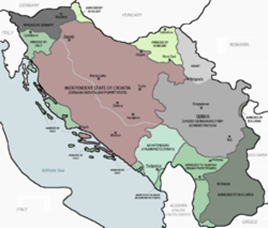
Leaving aside, for reasons of space, the very delicate analysis of the evolution of relations between Rome and Belgrade between 1918 and 1941, let us limit ourselves to recalling that the friendship agreements between Italy and Yugoslavia, signed on 25 March 1937 between Galeazzo Ciano and the Yugoslav Prime Minister and Foreign Minister Milan Stojadinović, were an act that sealed a real rapprochement between the two countries, due to an incipient convergence of views, which was part of the spirit of that period, in which the authoritarian countries seemed to exert greater attraction on the European populations than the liberal democracies. The events that occurred between 1937 and 1941 placed Yugoslavia in a state of growing tension and fear, due both to the decisive diplomatic and military action of Germany towards the Danubian-Balkan area and to the growing Croatian need to obtain greater autonomy within the Yugoslav institutional framework. After September 1939, the Yugoslavia of Regent Paul and the Cvetković-Maček government had to use all possible measures both to avoid antagonizing the overwhelming neighboring powers and to ensure its own state unity and neutrality in the face of the conflict. In this incandescent political atmosphere, Belgrade reached the painful decision to join the Tripartite Pact (Vienna, March 25, 1941). This caused the explosion of internal dissent, the coup d'état of March 26-27, 1941 by General Dusan Simović and the decision of Germany and Italy to intervene in Yugoslavia, causing its dismemberment and opening a Balkan front that, during four years of war, was the scene of unheard-of violence, involving Serbian monarchist Chetniks, Croatian pro-fascist Ustaša, Yugoslav communist partisans, German soldiers and Italian soldiers.
In the unstoppable spiral of fighting in the Yugoslav area, hatred grew progressively, following a deadly chain of actions and reactions and led to operations of unprecedented violence, which went beyond all limits. The relationship between cause and effect was close, in relation to every bloody action and every violent reprisal. No one should hide the fact that Germany and Italy waged a war of aggression against the Yugoslav population, but in examining the use of violence, which is present in every war, it is necessary to present the complete picture and allow public opinion to understand the real situation in which the Italian soldiers and officers found themselves fighting. Daily targets of attacks by Yugoslav resistance forces (bombings, explosions, rifle or machine gun fire from snipers hidden in the bush, knife fights), the Italian forces reacted in the name of the right of reprisal provided for by the military code. The photographs depicting the shooting of Yugoslav partisans or supporters of Yugoslav partisans were carried out by men in Italian military uniform, subject to the military code of war, which provides for the shooting of enemies guilty of bloody attacks against Italian forces or against the Italian population. This means that such Yugoslav partisans – in general – were not summarily massacred upon capture. They were not subjected to the abuse, torture and physical amputations that the Yugoslav partisan forces often resorted to against the Italians or that the Croatian Ustaša resorted to against the Serbs and the communists. In other words, shooting is, yes, certainly, an act of violence, but it is not comparable to the atrocities committed by those who, on the part of living Italian prisoners, eliminated their eyes with a knife or cut off their genitals or cut off their breasts, often exhibited as trophies of an embarrassing medieval tradition. The issue of prison camps also needs to be clarified. The Italians never carried out premeditated and scientifically prepared exterminations against the Yugoslav populations. War actions were subject to the control of the war code and the prisoners in the collection camps of Arbe, Gonars, Monigo were treated as prisoners of war: the numerous deceased perished mainly due to disease and malnutrition, as in the majority of prison camps. There were no gas chambers in the Italian camps, the aim of which was to carry out genocide against the Yugoslav population. The burning of villages took place, but not to make a clean sweep of the presence of the Yugoslav population, but rather to counteract those who sheltered the partisans or hid them. All these considerations – it is worth repeating – are not intended to justify any misdeed on the part of Italy, but to complete an extremely complex picture such as that of Yugoslavia during the Second World War.
The Italian armed forces, throughout all historical periods – from the period of the Kingdom of Sardinia to the Kingdom of Italy, from Fascism to the Italian Republic – have always served with discipline, seriousness and a sense of responsibility the political authority that controlled and directed them. It is no coincidence that from the wars of independence of the 700.000th century to the multinational peacekeeping missions in Lebanon, the Balkans, the Mediterranean and Afghanistan at the end of the XNUMXth century, the Italian armed forces have constantly shown the measure of their capabilities and their balance, of their humanity and their empathy with the entire world. The Balkan quagmire was always a very sad scene of brutal violence, which from the medieval era periodically continued until the XNUMXs, during the process of decomposition of Yugoslavia. If the observation period is limited to the Second World War, it is necessary to include all the tragic events that occurred in that period (about XNUMX Serbs were killed, mostly by the Croatian Ustaša, as the Jasenovac camp indicates), up to their final appendix, that is, up to the exterminations in the Istrian and Karst sinkholes by the Yugoslav communist partisans. Let us try to remember this too, so that a sad anniversary does not become the occasion to strike below the belt at the honor of Italy.
Stefano Pilotto – April 16, 2021
Source: Il Piccolo
 Language
 English