Language
 English

The Italian Community of Sissano celebrated polyvocality
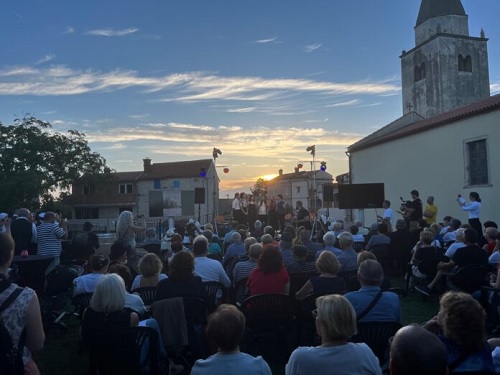
An evening dedicated to the yesterday, today and, why not, also the tomorrow, of singing and entitled "Polivocality of tradition" which, as in the previous two editions, was a success. A success thanks to the commitment of the Italian Community of Sissano, who put their heart and soul into preparing a rich program and making everyone feel at home: from the performers to those who appreciated the singing.
Two interesting preludes
The evening in Sissano had two very interesting preludes. The first appetizer was the opening of the exhibition in the multipurpose hall of the Italian Community entitled “Intangible Cultural Heritage of Istria – in the National List and in the UNESCO List”. The second one was experienced with the performance in the square of the Folklore Group of the local CI that met with the favor of those present. And as good hosts, after an introductory video in which the ethnomusicologist Dario Marušić spoke about the second CD of typical Sissano songs “Canto le mantignade e vado torno”, the members of the Folklore Group performed first by presenting “La me moroxa jo la campanela” and the song that gives the title to the new CD.
The fact that traditional songs do not belong only to the past was also demonstrated by the students of the Ivan Matetić Ronjgov Music School who, thanks to the work of ethnomusicologists Dario Marušić and Noel Šuran and under the guidance of professor Suzana Goldin, performed “Pred vašema vrati fiole” and “Da bi znala”.
A welcome return to the stage of the Sissanese Garden was that of the “Tenores Picotto Nugoro” from Nuoro in Sardinia. The Italian guests tried their hand at singing a tenore, which earned thunderous applause and a sincere “Evviva la Sardegna” from the audience.
Traditional songs of Istria
After crossing the Apennines, the song immediately returned to Istria, or rather to Barbana, whose artistic-cultural society wanted to pay homage to the kanat, a song used mainly by the Croatian population whose technique is also used in the mantignade of Sissano. The wandering around Istria and its traditional songs then brought the custodians and most active performers of the bitinàde, butunàde, àrie a cuntràda and àrie da nuòto to the stage, namely the SAC Marco Garbin of Rovigno. From Rovigno to Fabriano, in the Marche, the step is shorter than it seems and so the one to go on stage was Giovanni Cofani who first performed in a canto a vatoccu duet together with Edna Strenja Jurcan and alone in a canto a stesa.
Ping pong between the two shores of the Adriatic, united by song, brought the ball back to Istria, precisely to Chersano. Representing the Municipality of Albonese was the SAC “Ivan Fonović Zlatela” who performed the tarankanje and the kanat at close intervals in the version “na tonko i debelo”.
The folk groups of the Italian communities very close to Sissano also geographically could not be missed at an appointment with tradition, namely those of Gallesano and Dignano who presented their house specialties: the former enjoyed the “canti a pera”, the “canti ala longa” and the “canti xota le pive”, the latter (but only in order of performance) the bassi.
The spontaneous Resian songs
The vast list of guests of the evening dedicated to the “polyvocality of tradition” also included the debut at the event of the spontaneous choir of the folk group “Val Resia” of Friuli Venezia Giulia, composed of about ten elements that have in their repertoire the spontaneous songs of the Resian tradition. In Sissano they performed in the old Slovenian dialect. Closing the official part of the evening, which saw the talented Manuela Geissa and Claudio Grbac as presenters, was the klapa “Castrum Veneris” of Castelvenere who performed “Eviva el mar”, “Brkica” and “Projden kroz pasike”. Ended there? Nope. The evening in Giardin continued with the music of the Marche group “Mentua” from Fabriano.
The concert was held under the patronage of the Italian Union and the Office for Human Rights and the Rights of National Minorities of the Croatian Government and was organized by the CI of Sissano, which extended special thanks to the Istrian Region and the Municipality of Ližnjan, represented for the occasion by Mayor Marko Ravnić. Also present were the CNI deputy mayors of Pula and Rovinj, Bruno Cergnul and David Modrušan, as well as the President of the Council of the Autochthonous Italian National Community of the Istrian Region, Ennio Forlani.
“It was a very successful evening”, the hot comment of Paolo Demarin, president of the local CI and of the UI Assembly as well as “captain” of the organizing team composed of activists of the association, particularly proud of the publication of the second CD of traditional Sissanese songs. “This work of recording popular songs – he continued – we want to dedicate to all the Sissanese who over the years have been able to cultivate their singing and who today are no longer among us. To them our greatest recognition if today we can still sing our mantignade”. Finally, it should be added that the publication of the CD “I sing the mantignade and I go back” was supported by the ethnomusicologist Dario Marušić, Zoran Karlić of the SAC “Zlatela” of Chersano and Goran Farkaš, member of the ethno group “Veja”.
Julian Libanore
Source: The Voice of the People – 24/06/2024