Language
 English

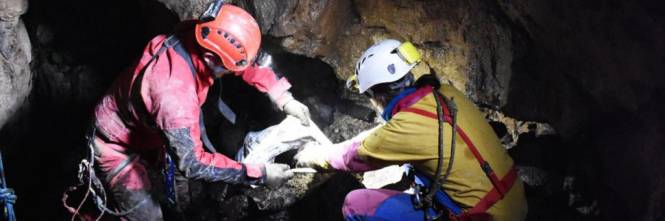
The foiba of the kids
Bones, skulls pierced by a bullet, but also small crosses and many buttons have come to light from the new sinkhole discovered in Slovenia.
by Fausto Biloslavo – August 6, 2020 – Source: Il Giornale
Bones, skulls pierced by a bullet, but also small crosses and many buttons have come to light from the new foiba discovered in Slovenia. The umpteenth horror of Tito's executioners, who massacred at the end of the war not only the Italians, but a quarter of a million Slavs who fought alongside the Nazis.
But there were also anti-communist Chetnik partisans.
The blood of the vanquished, but this time it is the massacre of the "innocents". Of the remains of 250 victims exhumed in the Kocevski forest, over a hundred were between 15 and 17 years old and at least five were women. Perhaps they were children recruited at the end of the Third Reich or the children of the families of domobranzi, the Slovenian troops deployed against Tito. En masse, together with the Croatian Ustascia they had surrendered to the English in Austria in 1945, but were sent back into the hands of the executioners at the end of the war. The Slovenians alone were 13.500 and almost all of them have disappeared.
The Union of Istrians, an association of Italian exiles forced to flee Tito's violence, posted photos of the latest horror on its Facebook page. The discovery and exhumation were organized by the Slovenian Government Commission for the Identification of Mass Graves, chaired by historian Joe Deman.
The sinkhole was discovered in May and exhumations began in July. "The human remains were covered by rocks and debris. The excavation team also found bodies on top of the debris," explains the speleologists' coordinator, Uro Koir. "That's why we suspect they were prisoners tasked with plugging the chasm, but they were later liquidated and thrown inside" to keep the secret forever.
A large quantity of shell casings were found in the sinkhole and on its outer edges. Analysis of the remains showed that many of the children had been killed by a shot to the back of the head or shot by being forced into the sinkholes.
The head of the investigation, Pavel Jamnik, blamed the Ozna, the Yugoslav secret police, for the massacre. The death squads were part of its "operational" arm, the Knoj, the People's Defense Corps of Yugoslavia, which was supposed to "clean up" the liberated areas.
«On June 24, 1945, an order came from Belgrade from Edvard Kardelj (Tito's right-hand man for the massacres, ed.) to speed up the cleanup because the amnesty was imminent» Dezman explained.
The number two of Tito's secret police in Slovenia was Mitja Ribicic, decorated in 1969 by the Quirinale with the high honor of Cavaliere di Gran Croce della Repubblica Italiana. In 2005, an investigation was opened in Ljubljana against him for war crimes, but insufficient evidence was found. After Ribicic's death, it emerged that he was "the one who decided which prisoners should die."
The new pit "is located in the area between Veliki Rog and Stari ag, in the immediate vicinity of an old partisan hospital and the remains were found at a depth of 14 meters," Koir said.
Speleologists descended into the abyss 68 times, bringing 137 loads of human remains to the surface. The operation lasted three days.
The Kocevski forest, in southeastern Slovenia, is a gigantic killing field, where over 5 victims of Tito have already been found. In the small country of the former Yugoslavia, the government commission has identified 750 mass graves, most of which have yet to be explored. Near the border with Italy, there are about eighty of them, and they could also contain remains of Italian victims.
This is why the large "Tito" writings with white stone in Slovenian territory on Mount Cocusso near the Trieste Karst and on Sabotino above Gorizia, which can be seen from miles away, are increasingly out of place. Both Trieste and the Isonzo capital suffered occupation by Yugoslav partisans after the war, with deportations and sinkings into the sinkholes. And right now, the red leader's face is standing out on Istrian newsstands, in the weekly Express, with a hair-raising headline: "Tito as a brand" for the future of Croatia?