Language
 English

The Italian province of Carnaro
In 1900, the city of Fiume was a "Corpus Separatum" subject to Hungary within the Habsburg Empire. According to the official census of that year, the population living in the city center and the suburbs of Plasse, Drenova and Cosala (also included in the "Corpus" mentioned above) amounted to a total of 38.955 souls. In the census of 1910, the last one to be carried out in the political structure indicated above, it was found to have 49.806. From subsequent surveys by various institutions we have the following data: in 1918 (census of the Italian National Council) 46.264 inhabitants, in 1925 (Italian census) 45.857, in 1936 (Italian census) 56.249, in 1940 (Official surveys of the Italian Prefecture of Fiume) 59.332, in 1945 (Surveys of the Citizens' Popular Committee, provisional administrative government body of the city, occupied by the Yugoslav Liberation Army) 44.544 on 31 May and 47.839 on 30 September.
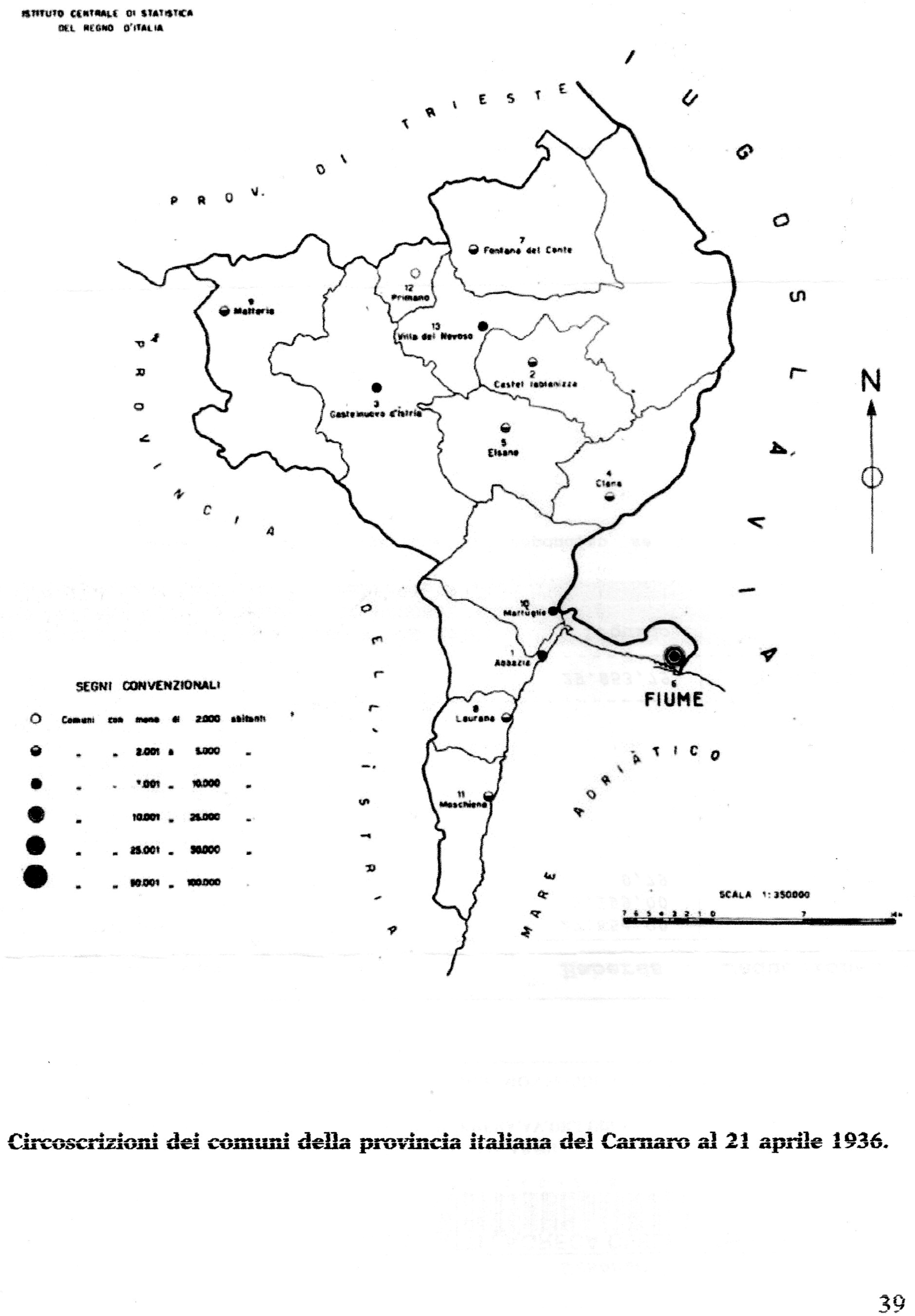
In the territory of the Italian province of Carnaro, established in 1924, there was a total population of 99.941 inhabitants. There were 40.433 Italians; 53.722 Slavs, almost equally divided, in our opinion, between Slovenes and Croats. In the capital, however, there was a large Italian majority: 32.415 Italians and 10.353 Croats out of 45.857 inhabitants.
1924 census and subdivisions based on the language used in the Province of Carnaro (1924):
Municipalities taken from the province of Pula:
Apriano, (aggregated to Abbazia in 1931) inhabitants 2.892 – 489 Italians, 17 Slovenes, 2.166 Serbo-Croats.
Castelnuovo d'Istria inhabitants 7.259 – 177 Italians, 5.520 Slovenians, 1.726 Serbo-Croats.
Clana inhabitants 1.235 - 108 Italians, 15 Slovenians, 1.098 Serbo-Croats.
Elsane inhabitants 4.127 – 28 Italians, 3.623 Slovenians, 460 Serbo-Croats.
Laurana inhabitants 3.648 – 1.634 Italians, 29 Slovenians, 1.837 Serbo-Croats.
Matter inhabitants 5.104 – 23 Italians, 3.733 Slovenians, 1.325 Serbo-Croats.
Mattuglie inhabitants 8.777 – 234 Italians, 66 Slovenians, 8.338 Serbo-Croats.
Moschiena inhabitants 3.060 – 3.013 Italians, 3 Slovenians, 13 Serbo-Croats.
Volosko-Obazia, inhabitants 5.062 – 2.297 Italians, 343 Slovenians, 1.081 Serbo-Croats.
Municipalities taken from the Postojna district (the lack of data does not allow us to divide the Slavs between Slovenes and Croats even if this district, today part of the Republic of Slovenia, could also be said to have been inhabited mainly by Slovenes):
Castel Iablanizza, inhabitants 3.106 – 0 Italians, 2.306 Slavs (not divided between Slovenians and Croats due to unavailability of data).
Fontana del Conte inhabitants 3.719 – 5 Italians, 3.710 Slavs (same as above).
Primano inhabitants 1.547 – 6 Italians, 1.524 Slavs (same as above).
Villa del Nevoso inhabitants 4.548 – 4 Italians, 4.451 Slavs (same as above).
Based on the above, it can be stated that the Italian province of Carnaro, excluding the capital, was inhabited, in 1925, according to the language in use, by: 8.018 Italians, 13.334 Slovenes, 18.044 Serbo-Croats and 11.991 who could be generically defined as "Slavs", as we lack any data relating to the language in use, which however we believe, considering the territory of origin, was the large majority Slovenian. In 1940, according to the Prefecture of Fiume, there were in the capital 41.314 Italians, 11.199 "alien", 6.933 foreigners and 1.146 individuals with dubious citizenship or stateless.
After the invasion of Yugoslavia, with the inclusion of the "annexed territories of Fiumano and Kupa" in the province of Carnaro, municipalities passed under Italian administration in which the language spoken by the absolute majority of the inhabitants was Croatian and where small Italian minorities were detectable only in Sussak, Veglia and Arbe. In total, 24 municipalities of which we report the Croatian name followed by the Italian one: Sussak-Sussa, Crnik Cavle-Zaule, Grobnik-Grobnico, Praputgnac-San Giuseppe, Jelenje-Cervi, Krascica-Villacarsia, Bakar-Buccari, Kastav-Castua, Crni Lug-Bosconero, Cabar-Concanera, Draga-Valle, Osilnica-Vallombrosa del Carnaro, Plesce-Plezze, Gerovo-Gerovo, Prezid-Vallogiulio, Trava-Pratalto, Aleksandrovo-Ponte Baska-Besca, Dobrinj-Feliciano, Dubasnica-Roveredo, Krk-Veglia, Omisalj-Castelmuschio, Vrbenik-Verbenico, Rab-Arbe. Overall, over 90.000 Slavs, mostly Croats, who added to the other 60.000 or so (also defined as aliens) existing both in the old province (data from 1924) and in the capital (data from 1940) would make a total of around 150.000.
Between June 1940 (Italy's entry into the war) and May 1945 (the establishment of the People's Liberation Committee), according to the aforementioned surveys, the population of the capital declined by approximately 15.000. Although there was a recovery of approximately 3.300 (mainly due to returns from prison or military service in Italy and elsewhere), between May and September of the same year, it can be said that there was a definitive population decline of at least 22%. We believe this percentage primarily impacted the Italian presence in Rijeka, reducing it by approximately 7.000. Between 1946 and 1950, according to estimates by the Organization for Refugee Assistance in Italy, more than 25.000 Italians left the city. In various, unspecified years, before 1943 and after 1950, approximately another 6.000 people left. The above estimates, extremely conservative, would demonstrate a reality—that of the massive and spontaneous exodus of Italians from Fiume—which still awaits careful study today, using data held in the historical archives of the municipal registry of the present-day city. This reality has been subject to overestimations and inappropriate reductions at various times, driven by political passions, but its true size, pending more detailed verification, seems reasonably close, barring errors and omissions, to at least 86% of the Italians present up to 1940 in the old Province of Carnaro as it had been territorially delimited in 1925.
We have reason to believe that there was also a migratory movement of Slavs or those defined as "alloglots" between 1943 and 1945, but we have no reliable information on this phenomenon.
The present city of Fiume, today called Rijeka within the Republic of Croatia, is included in the Primorje-Gorski Kotar County. Together with the city of Sussak, it had, in 1991, 167.964 inhabitants. In 1963, it had, together with Sussak, 102.000 and alone 87.000.
The members of the Italian communities that arose in the municipalities of the former Italian province of Carnaro were, as of 19967: 4.697 in Fiume, 590 in Abbazia and 209 in Laurana.
by Amleto Ballarini
Based on Amleto Ballarini – Giovanni Stelli – Marino Micich – Emiliano Loria, The Foibe, the Exodus, Memory. Venezia Giulia Fiume Dalmatia , Association for the Culture of Fiume Istrian Dalmatian Culture in Lazio, Rome 2015.