Language
 English

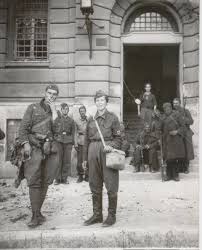
The tragic days of May
On May 1, 1945, Tito wins the “race for Trieste”: deportations, sinkholes and massacres throughout the Julian March
Tricolor flags, patriotic songs, war veterans, partisans who fought in the Resistance and young people parade through the streets of Trieste on May 5, 1945: bursts of machine gun fire, deaths, gunshots, injuries, shouts in a foreign language and the fleeing crowd put an end to this claim for Italianness, freedom and democracy. It seemed like a demonstration like many others that were taking place in those days in Italy, but the outcome was tragic and unique because the event took place in the capital of Venezia Giulia, a border province in which the Second World War did not end on April 25, but rather continued with a new foreign occupation, a new clandestine struggle and new victims.
The atypical nature of the situation in Trieste emerges already in the insurrection of the National Liberation Committee, which took place here only on April 30, since the city was still firmly in German hands within the Adriatic Coast Operations Zone, a sort of German military governorship that after September 8, 43 extended over Trieste, Gorizia, Udine, Ljubljana, Pola and Fiume, annihilating the authorities of the nascent Italian Social Republic and starting over a year and a half of fierce anti-partisan struggle in which the dialectic of fascism/anti-fascism was superimposed by a conflict for the future territorial belonging of these border lands. The Nazi authorities, dusting off the myth of Trieste as the sea outlet of Central Europe (formerly represented by the Austro-Hungarian Empire that gave rise to the port and economic fortunes of Trieste and now embodied by Adolf Hitler's thousand-year Reich), have gathered consensus among nostalgic Habsburgs, fringes of Slovenians and other Italophobic collaborators and in the anti-guerrilla warfare they apply the most violent and bloody tactics refined in the fighting against the Soviet partisans on the Eastern front and set out in the manual "Bandenkampf". The Slovenian Communist Party is hegemonic among the forces of the resistance and inexorably places the destiny of these provinces within the reborn Yugoslavia, socialist and federal under the aegis of Josip Broz "Tito". The RSI has few troops on the field: it has only been able to set up some units of the Territorial Defense Militia (the German authorities have forbidden the creation of units of the Republican National Guard) while in Istria and in Carnaro there are nuclei of the Decima Division, the vanguard of a more complex project for the defense of the eastern border that has not materialized. The CLN is divided internally because the communists support the Slavic claims, communicates little and badly with the leaders in Milan and already weak from the start is particularly affected by Nazi repression through denunciations, deportations and arrests at the detention camp of the Risiera di San Sabba, where ruthless interrogations take place, a crematorium operates and trains leave for the concentration camps.
At the end of April, the “race for Trieste” also took place: on the one hand, the Anglo-American armies wanted to conquer Trieste to exploit the port and its connections with central Europe as a logistical base for the final phase of the conflict and for supplies to the troops that would occupy Austria and southern Germany; on the other hand, Tito had given the order to neglect the liberation of places like Ljubljana and Zagreb, whose belonging to the future Yugoslavia was out of the question, to concentrate on the occupation of Trieste, Gorizia, Istria and Fiume, so as to constitute, with the military presence during the imminent peace negotiations, a deposit on the internationally recognized annexation.
With the support of the soldiers of the Trieste Legion of the Guardia di Finanza and the Volontari della Libertà infiltrated into the police force of the Guardia Civica established by Podestà Pagnini, the CLN of Trieste manages to unleash the anti-German insurrection in the center of Trieste on April 30, while Slovenian and communist partisans operate in the outskirts, so that at the end of the day the German troops are barricaded in some fortified points waiting to surrender to a regular army. At the first light of dawn the next day the vanguard of the People's Liberation Army of Yugoslavia arrives in Trieste, anticipating the motorized columns of New Zealand that open the way for the Allied armies and in effect the city is plunged back into conflict.
The Ciellenist authorities were removed and a clandestine CLN was reconstituted, the annexation of Trieste to Yugoslavia was declared (so much so that the clocks were set to Belgrade time) and the OZNA, the Yugoslav political police, went into action. Thanks to proscription lists compiled by local Italian and Slovenian communists, it unleashed a wave of arrests, trials and executions against fascists, considering anyone who opposed Tito's annexationist project as a "fascist". In this way, not only people implicated with the fallen regime and soldiers who had surrendered, but also patriotic partisans, intellectuals and entrepreneurs disappeared into thin air. Some were thrown into sinkholes, some were deported to concentration camps set up in Yugoslavia, dying of hardship during the forced approach marches or because of the terrifying detention conditions. Gorizia, Fiume and Pola are also living this nightmare, which for the Istrian hinterland represents the repetition of the first tragic wave of killings in the foibe that occurred the day after September 8. The presence of Anglo-American troops in the city is irrelevant, as shown by the dead and wounded of the patriotic demonstration of May 5 (a plaque today commemorates them at the site of the massacre, at the crossroads between the central Corso Italia and Via Imbriani), because they do not want to come to a clash with the Yugoslavian allies or because, the British leaders in particular cynically reason, these massacres could be useful in the future in the context of anti-communist propaganda.
In light of this violence and cruelty, which will partially end on the following 12th June, when the Yugoslav occupiers will have to leave Gorizia, Trieste and Pola to the Anglo-American military administration, it is clear why for the Istrian, Fiume and Dalmatian exiles and for many Julians the date of 25th April does not represent the end of the Second World War, but only the beginning of an ordeal characterised by thousands of deaths and tens of thousands of exiles.
Lorenzo Salimbeni
Source: Il Giornale d'Italia – April 29, 2018