Language
 English

The forgotten exodus of Dalmatians after the Great War
The National Dalmatian Association has reprinted the documentary that illustrates the fate of our fellow countrymen after the Treaty of Rapallo
Thanks to the generous contribution of the Terzo Pilastro – Internazionale Foundation, the National Dalmatian Association has been able to reprint the DVD “1921 The ignored exodus. The drama of the Italians of Dalmatia”, which appeared in its first edition a dozen years ago. This documentary is enriched by geographical maps, period postcards and above all images from the archive of Manlio Cace, who lived the days of the exciting arrival of Italy on 6 November 1918 in Sebenico and the consequent disappointment of the cession to the Kingdom of Serbs, Croats and Slovenes which gave rise to the exodus of his family, with deep irredentist traditions, together with thousands of other Dalmatians. This exile of about 20.000 of our compatriots represented in the most dramatic way the “mutilated victory”.
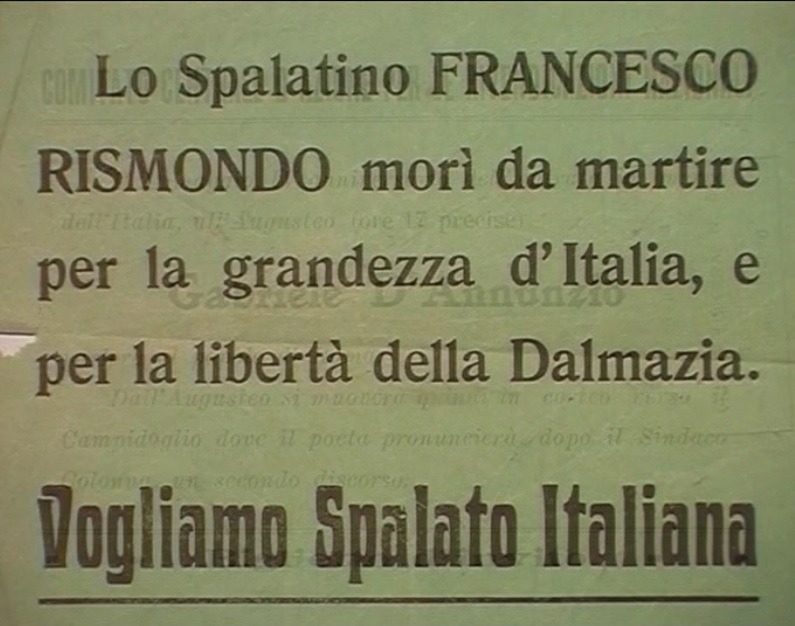
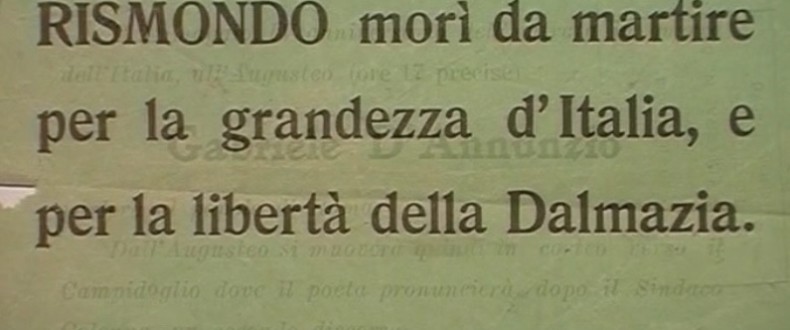
On Tuesday 15 May, the president of AND Guido Cace presented this precious document in the prestigious Sala Zuccari in the Senate of the Republic. The document first of all provides an overview of the main figures of Dalmatian irredentism (Ziliotto, Ghiglianovich, Cippico, Salvi and Rismondo, to name a few) and recalls how the London Pact signed by Italy on 26 April 1915 contemplated the cession of all of Northern Dalmatia to Italy in the event of the defeat of the Austro-Hungarian Empire. The Dalmatians who were imprisoned or interned during the Great War because they were considered subversives by the Habsburg authorities are remembered, as are those who fell on the battlefield (14 fallen out of 209 Dalmatians who, having escaped to Italy, fought in the Royal Army) and the mysterious fate of Francesco Rismondo (did he fall during an assault or was he killed during an escape attempt from an Austrian prison camp?) and Gabriele d'Annunzio's plan to fly over Zadar to drop propaganda leaflets there, as had already been done in Trento and Trieste, but which was never realised due to the death of its pilot.
Thus we arrive at the end of the conflict, with the establishment of a National Fascist Party and a National Guard in Zadar, which ensured public order until the arrival, on November 4, 1918, of Torpedo Boat 55, which landed the first Italian troops. In the name of the victorious powers, they occupied Dalmatian territory, soon encountering Slavic committees who instead claimed the eastern Adriatic coast for the nascent Yugoslav state. Drawing on the Cace photographic archive, the documentary then focuses on the events in Šibenik, where the torpedo boats Pallade and Albatros paraded on November 6 under the Italian flag already flying on the battlements of Fort San Michele, despite opposition from local Yugoslavians. Not only the military garrison, but also illustrious guests such as the nationalists Federzoni and Delcroix as well as Guglielmo Marconi came to the city that gave birth to Niccolò Tommaseo to reaffirm its Italianness.
Nevertheless, the Treaty of Rapallo signed by the Kingdom of Italy and the Kingdom of Serbs, Croats and Slovenes on 12 November 1920 set the border in such a way as to leave only Zara under Italian sovereignty: in D'Annunzio's Fiume the answer would have been a Bloody Christmas, in Dalmatia annexed to the kingdom of the Karađeorđević there would have been the exodus of almost all the Italian communities of Sebenico, Spalato and Traù, for which 3.000 refugees stopped in Zara, thousands more poured into the peninsula, concentrating in Rome and Trieste in particular. This flow of exiles was in continuity with the emigration of those Dalmatians who at the end of the nineteenth century suffered the discriminatory Austro-Hungarian policies that had favored the rise of the Croatian component, more loyalist than the Italians suspected of irredentism. Sebenico in 1873, Spalato in 1882 and in between many other municipal administrations passed from the traditional Italian ruling class to the Croatian one, in 1905 Italian was banned from official documents and Zadar remained the last stronghold of Dalmatian Italianity. Fringes of today's Croatian nationalist historiography seem to retrace this denationalizing mentality when they present Dalmatia exclusively as the cradle of Dalmatian culture, glossing over its Roman, Venetian and Italic vestiges.
Commenting on what has just been seen, Ambassador Giulio Terzi di Sant'Agata recalled how this tragic exodus was a consequence of the "Wilsonian principle of nationalities that gave to some and denied to others". The Treaty of Rapallo is therefore considered as the inevitable consequence of the fact that the English and French had promised the same lands in the eastern Adriatic to different interlocutors, then advocating the union of the Serbian government in exile with the Yugoslav committees that had left the dual monarchy in such a way as to arrive at the Corfu Declaration of 20 July 1917 which outlined the future Yugoslav state. If Rapallo represented a renunciation of what had been promised, even more blatantly renunciatory and submissive was, according to the diplomat, the Treaty of Osimo, with which Italy in 1975 officially defined its border with Titoist Yugoslavia without claiming at least Zone B (Koper and Buje) of the never-established Free Territory of Trieste. Finally, recalling the educational merits of the National Dalmatian Association, Terzi also mentioned the terrifying photographic reportage “Report on the treatment of Italians after 8 September 1943” which collected evidence of the massacres in the foibe and of the ethnic cleansing unleashed by Tito's partisan army in Istria. Based on material collected by the Italian Navy's secret services, this memorial was delivered to Alcide De Gasperi to present at the Peace Conference, but the Trentino statesman preferred not to use it so as not to sever political relations with the socialists and communists, so that, like Vittorio Emanuele Orlando during the negotiations following the end of the First World War, the Italian representative pleaded his own cause when everything had already been decided elsewhere.
Lorenzo Salimbeni
Source: February 10 Committee