Language
 English

Italians don't go on holiday
We share this article from the February 10 Committee website , previously published in the newspaper "Avvenire," by Professor Alessandro Masi, Secretary General of the Dante Alighieri Society and Councilor of the National Dalmatian Association.
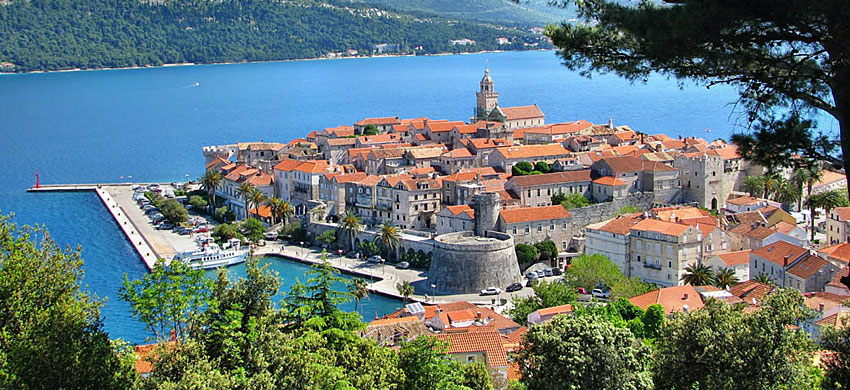
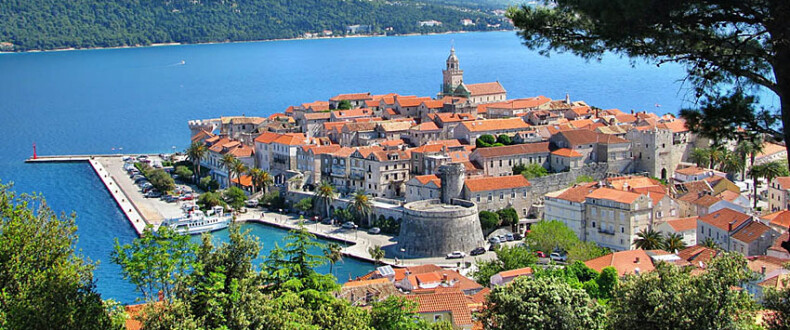
Unlike Venice, in Korčula, the most beautiful island between Split and Ragusa, cruise ships cannot dock. Stopped two miles from the port, the monstrous floating cities vomit out hundreds of tourists every day, often unaware of everything. The large statues of the lions of the Serenissima Republic placed on the bastions of the city, slyly watch the scene in memory of a past that has never passed on this island, not even in the times of Tito's communism. After all, the testimonies of art preserved here, above all those of the cathedral of Sveti Marko (St. Mark), are indelible. The hand of the Italian sculptors who crowned the facade with the beautiful anthropomorphic portal and the Romanesque bell tower that stands out over the roofs, probably did not know that they were preparing a jewel that would also set the precious paintings of a great Venetian artist, Tintoretto. This island claims the birthplace of another famous Italian, but perhaps it would be better to say Venetian-Dalmatian, Marco Polo, proudly displaying his house (Kuća) and small shops with cheap and ugly souvenirs. What the documents could say instead is that on the distant 8th September 1298, in the waters opposite, a furious naval battle took place between the Genoese and the Venetians (the Battle of Curzola), in which Marco Polo himself was taken prisoner.
Every morning at six o'clock, sharp to the second, the bronze bells of the cathedral joyfully signal the beginning of the new day, reminding all the inhabitants of beautiful Korcula, the black and sweet Korkyra, as the Greeks called it, of their daily commitments made up essentially of small things. Some local elders at the market still show off a precious Italian, delicate as Murano glass, a reminder of the fascist occupation of 1942-43, when the madness of Europe also hit this paradise of light and colors and here Calabrian and Neapolitan teachers were ordered to forcibly teach the language of Dante. A graft that produced various effects but not those of social or even political integration.
A study from a few years ago by the sociolinguist of the University of Zagreb (a native of the island, born in 1932), Damir Kalogjera, conducted together with two other colleagues, Mirjana Fattorini Svoboda and Višnja Josipović Smojver, catalogues thousands of words, a large part of which are of Italian origin or, better said, Venetian-Dalmatian. “Rječnik govora grada Korčule” (“Dictionary of the language spoken in Korčula”, Novi Liber, Zagreb 2008) is the title of the volume that testifies to today's reader how deep the ties were that for centuries united the two shores of the Adriatic in what in ancient times the geographical maps called the Gulf of Venice. First of all, the jargon of the sea and the navy with the terms arsenãl (arsenal), parangãl (parangale), trampulîn (trampoline), majstrãl (mistral), kanoćãl (telescope); the more familiar ones like sinjorîna (young lady), pápe and máma (father and mother) and the home ones like jogàtula (toy), jës (chalk) and the kitchen ones, pérśut (ham), salsa and makarunj which do not need translation, but only a taste to enjoy their goodness and that of the tomato sauce, precisely, in which they are immersed. But these are just a few examples of a much broader vocabulary. Even if Damir Kalogjera does not write it, it seems completely obvious that this document wants to be a sort of linguistic testament of a civilization that for centuries has shared history and traditions in a context completely unusual for the Balkans, proudly preserving a natural bond also with Italy. It is a linguistic heritage that we must take into account for our future and that of the new generations of Europe if we really intend to continue in the direction of true multiculturalism. The standardization of English, today deployed here with full force in travel agencies, supermarkets, shops, cafes and among young people, levels down a linguistic variety that, in this pearl of the Adriatic, should be preserved as a nature reserve.
Alessandro Masi