Language
 English

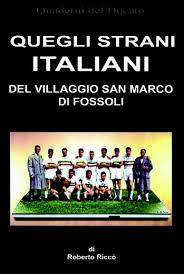
Those strange Italians from the Villaggio San Marco in Fossoli
Roberto Riccò, "Those Strange Italians of the Village of San Marco in Fossoli ," Terra e identità, no. 89, Modena, 2019, 192 pages, with black and white photographs, €12; the volume can be ordered at info@terraeidentita.it
by Elio Varutti – 03/08/2020 – Source: https://eliovarutti.wordpress.com/2020/03/08/un-libro-sui-profughi-istriani-del-villaggio-s-marco-di-fossoli-di-carpi-mo/
Roberto Riccò's volume on the Villaggio San Marco di Fossoli, active from 1954 to 1970, fills a certain gap. It is true that a miscellaneous text had already been assembled to mark the 60th anniversary of its foundation for the national study conference organized by the Modena Provincial Committee of the National Association of Venezia Giulia Dalmatia (ANVGD). This work was published in 2016. However, a work that collected extensive testimonies from the protagonists of that period of life was missing, from their escape from Istria, Fiume, and Dalmatia to their integration into local society, despite the great difficulties encountered. The native population held a communist political outlook, while the exiles were fleeing the abuses of the Yugoslav communists, who occupied their homes, requisitioned their businesses, fields, assets, beds, and chairs for the benefit of the Yugoslav people. The new authorities who took office failed to take into account that, especially on the coast, the ancestors of the Italians of Istria were predominantly Venetian, Byzantine, and Roman in language and culture. The Kingdom of Italy arrived in 1918, and Fascism came after 1922, leaving their mark on the history books with the harsh experience of so-called border fascism , the linguistic cleansing of alloglots, the proclamation of the Racial Laws in 1938, and the invasion of Yugoslavia in 1941, under Axis forces. Consequently, the Yugoslavs saw every Italian as a fascist they could retaliate against by killing in the foiba, out of revenge or as part of a planned ethnic cleansing orchestrated by OZNA, the secret service of Tito's militia.
These aspects are presented in the first part of the book, transforming it into a great act of dissemination. Then there is the chronicle of the arrival in Fossoli of the first families of Istrian refugees and their thwarted social integration, until the assignment of the definitive apartments in via Ponente in Carpi, during the 70s.
Let's go in order. There are 7 phases of activity of the Fossoli Camp. Built in 1942, when the Royal Italian Army set up tents to house English, South African and New Zealand prisoners of war, it was the PG 73, or Prison Camp No. 73, where 5.000 prisoners passed. From 5 December 1943 it was transformed into a concentration camp for Jews of the Italian Social Republic (RSI). Under the armed escort of Italian soldiers, the first convoys of Jews left for the Nazi extermination camps. On 22 February 1944, with the second transport, Primo Levi, arrested in December 1943 in the Aosta Valley with a partisan group, also traveled in cattle cars. At that time the structure consisted of dozens of brick huts, all later dismantled, it was the so-called old camp. On March 15, 1944, it was transformed by the Nazis into a Police and Transit Camp. It was the main Italian concentration camp, since the San Sabba camp in Trieste was in an operations zone of the Third Reich, no longer being part of Italy. 2.844 Jews and 2.000 political prisoners left Fossoli.
On 2 August 1944, with the advance of the war front, the Camp was closed and transferred to Bolzano-Gries, so Fossoli was a collection centre destined for forced labour in the territories of the Reich with the Todt Organisation. After the end of the conflict, the Camp welcomed fascists and military and civilian collaborators. From August 1945 to 1947 it welcomed refugees and Jews returning from Nazi concentration camps. From 1947 to 1952 Don Zeno Saltini welcomed over 1.000 abandoned and orphaned children and young people. In 1954, 16 buildings were built to accommodate refugees from Istria, Fiume and Dalmatia until 1970; they fled from their lands assigned by the Peace Treaty to Yugoslavia. They were 250 families, for 1.500 people.

The author of the book was able to carry out his research at the Municipal Historical Archives of Carpi and in the Diocesan Historical Archives of the Modena town, as well as at the Historical Institute of the Resistance of Modena. In addition to the help of the Banca Popolare dell'Emilia Romagna, the publication enjoys the collaboration of the local University of the Third Age and the Modena Provincial Committee of the National Association of Venezia Giulia and Dalmatia.