Language
 English

New foibe discovered
A team of speleologists exhumes the bodies of the victims of a Titoist massacre: among them 100 adolescents and 5 women, all shot in 1945. Rosaries and combs were found in the 14-meter-deep cavity.
By Lucia Bellaspiga – August 27, 2020 – Source: Avvenire
Hundreds of children, little more than boys, dragged to the edge of the Foiba and slaughtered there by rifle fire. The luckiest fell dead into the void; for the others, a long agony ended the torture. For decades, the voices of the survivors of Marshal Tito's massacres have told us all this, but this time, the bodies of the victims speak for themselves, found in recent days by a team of Slovenian speleologists in the Kočevski Rog area, in the immediate vicinity of an old partisan hospital.
Slovenian historian Jože Dežman, head of the State Commission for the Identification of Mass Graves , described the chilling discovery at a press conference : “Over a hundred of them were children between the ages of 15 and 17, and among them we also found five women.”
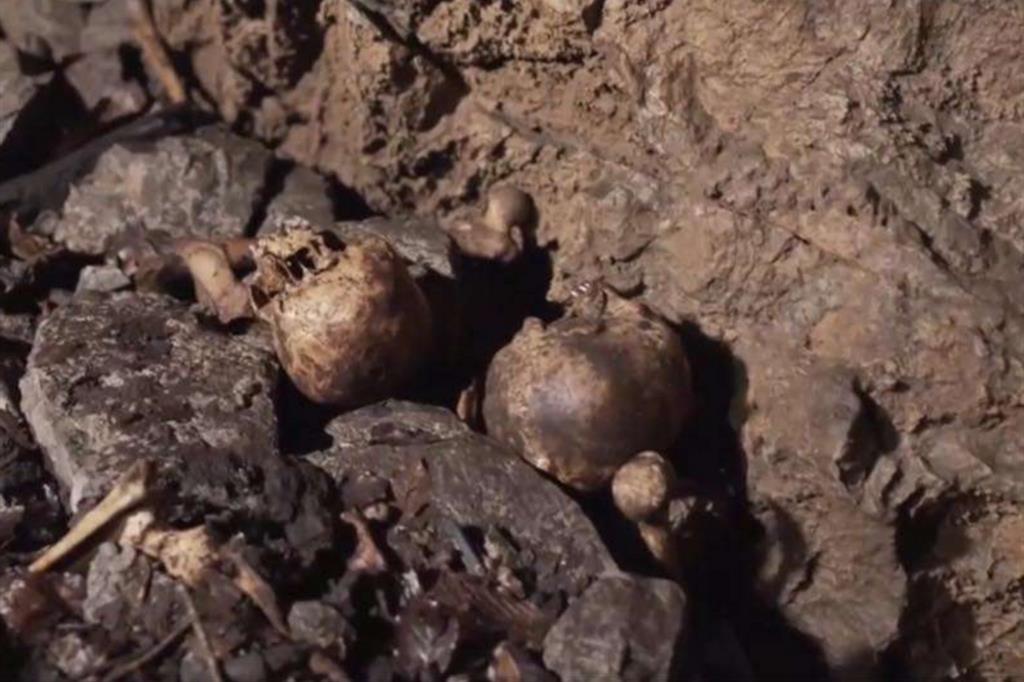
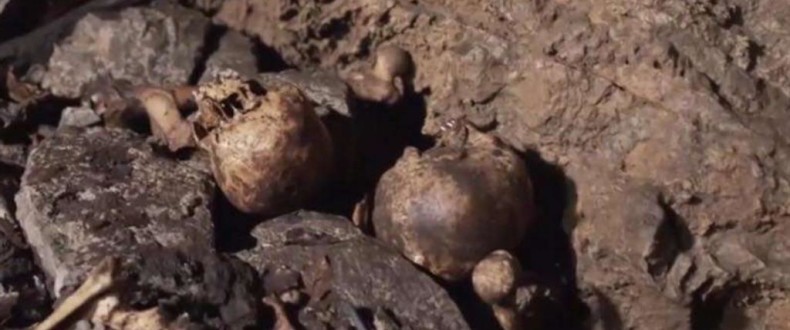
The team of speleologists had to descend into the cavity 68 times to recover a total of 250 bodies, almost all civilians and very young, as well as the humble personal objects that had fallen with them at the moment of death , tragic glimpses of the last moments of life.
Archaeologist Uroš Košir, coordinator of the recovery operation , listed them one by one : “In addition to the human remains,” he told journalists, “we found rosaries, sacred images, combs, mirrors, spoons… And about 400 buttons” (the touching photos made available at the press conference and also relaunched on the Facebook page of the Union of Istrians).
Zdravko Bučar, a speleologist, explained that the excavation inside the natural cavity, 14 metres deep, had been authorised in May, as part of the works entrusted to the State Commission dealing with the massacres committed by Tito's followers, and at the beginning of July the first descent was carried out , with the first macabre discovery of what probably happened in a single night in 1945.
Facts that no one has ever been able to tell, but which now emerge all too clearly: according to the archaeologist Košir, both in the Foiba and along its external edges the large quantity of ammunition proves that the mass execution was committed on the spot, therefore that the boys, brought there alive, lucidly experienced all the phases of their elimination and saw with their own eyes the abyss into which they would be thrown.
Not only that: "the remains of the victims were covered with rocks and debris, but on top of these we found other bodies, which suggests that the prisoners charged with covering the abyss were killed and thrown into the pit last. From the analysis of the wounds found on the skulls, all the victims were killed with automatic rifles".
Three full days to bring the 250 bodies back to the surface. Sixty-eight times the courage to descend to bring back so many skeletons so well preserved that they still tell all the terror experienced. And the dear objects certainly close to the heart at the moment of death, remained down there for these 75 years, next to their owners. And then all those bullets inside and outside the Foiba…
It's impossible not to think back to the testimony of Graziano Udovisi, one of the very few to have escaped alive from a Foiba, throwing himself inside before the bullet struck him and climbing the impervious walls until he emerged into the light. It's impossible not to recall the images of "Red Land," the film released a year ago to tell the story of the death of Norma Cossetto, thrown alive into the Surani Foiba. And then there's the testimony of Giuseppe Comand, the last remaining firefighter who, in 2018, at the age of 97, told us about the recovery of poor Norma and clusters of other bodies . Interviewed by Avvenire , he was later named Commander of Merit of the Republic by President Sergio Mattarella.
In short, these are all things we Italians already knew all too well from the stories of Istrian, Fiume, and Dalmatian exiles, but which in recent years have found increasing confirmation in the research conducted by both Croatian and Slovenian authorities, increasingly committed to tearing away the veil of decades of silence and shedding light on the crimes of Tito's regime . This is a sign that the two republics born from the collapse of the former Yugoslavia have truly embarked on the path to truly overcoming a dark past and are definitively distancing themselves from a dictatorship that has claimed so many victims among their own peoples, as well as among Italians.
So who are the 250 people killed at Kočevski Rog? They too, like thousands of our other sinkhole victims, will never be named, while somewhere their families still mourn them as if they had vanished into thin air, and just as many empty graves will continue to clamor for the truth. But in this case, a clear lead comes directly from the Slovenian head of the police investigation, Pavel Jamnik, who has no doubts: cross-referencing data and testimonies on partisan activity in that area, responsibility for the massacre lies with the OZNA, the infamous Yugoslav secret police , and specifically with its operational arm, the KNOJ (Korpus narodne obrambe Jugoslavije), the People's Defense Corps of Yugoslavia.
An important confirmation of the work recently conducted by the young Italian historian William Klinger, who in his book “Ozna, the terror of the people” indicated exactly in the area of the sinkhole the place of a ferocious massacre.
In 2018, thanks to the testimony of Father Franjo Jurcevic , parish priest of Kastav (Rijeka) , Croatian authorities collaborated with Italian authorities in the discovery of a similar mass grave, the exhumation of the seven Italians who had been thrown there, and finally their burial 75 years after their deaths. The vox populi had always indicated that forest as the site of their execution… A sign that the memory of the last witnesses must be heeded, and quickly. Anyone who still tries to deny the Foibe belongs to a dead and buried past.