Language
 English


“Infoibate Truths” by Biloslavo and Carnieletto
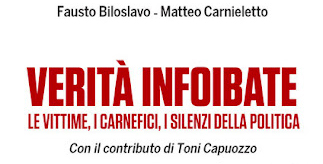
All those "infoibate" truths about the massacres wanted by Tito. Biloslavo and Carnieletto tell decades of systematic cover-up of memory. by Matteo Carnieletto - Fausto Biloslavo 06/02/2021 Source: Il Giornale «Infoibate truths» brings to light dark pages of our past hidden for too long, which in reality still sink into the present thanks to political opportunism, banal conformism, fear of going against the grain or total disinterest. From the new American president who admires Tito to the decoration of the Quirinale still pinned on the Marshal's chest, up to the foibe discovered in Slovenia, the denied justice and the outrages to the martyrs of the...

45 years ago the Treaty of Osimo
November 10, 1975, Treaty of Osimo: if September 8 outrages you, this date should make you scream with rage by Davide Rossi and Lorenzo Salimbeni - 10/11/2020 Source: l'Adige The end of the First World War in November 1918 did not mean the immediate pacification of the Continent, tormented by nationalist claims eager to overturn the borders and by revolutionary ferments inspired by the Bolshevik revolution. Gabriele d'Annunzio's expedition to Fiume at the head of his legionaries represented for Italy the most striking appendix of the conflict, while military missions were located in various crisis areas (Carinthia, Silesia, etc.) and a significant...

Anachronistic red star in Fiume
The decision by Mayor Vojko Obersnel to place a giant red star on a city skyscraper, as part of the initiatives of Rijeka European Capital of Culture 2020, has caused dismay not only among many residents of the capital of Carnaro, but also within the world of Istrian, Rijeka and Dalmatian exiles and the native Italian community. This communist symbol is supposed to commemorate the fallen partisans around Rijeka in the final phase of the Second World War, but the numbers of victims during those battles have been inflated and, above all, no reference has been made to what happened after those battles. Undoubtedly, the entry of the...

Tito's Partisans in the Resistance
“Describing the role of the Yugoslav partisans in the Italian Resistance goes far beyond the study of the dramatic chapter of the Civil War. In fact, it means immersing oneself in the analysis of an area of the world, the Balkans, in which ethnic conflict surpasses diatribes and ideological clashes” says Marco Petrelli, journalist and author of I partigiani di Tito nella Resistenza Italiana (Mursia, 162 pages, Euro 17,00). Source: Agrpress - 05/09/2020 On the date of the communication of the Armistice with the Anglo-Americans, thousands of prisoners of war and civilians from enemy countries were interned on Italian soil. Among them, many Slavs who fell into the hands of the Axis forces...

The foiba of the kids
Bones, skulls pierced by a bullet, but also small crosses and many buttons have come to light from the new sinkhole discovered in Slovenia. by Fausto Biloslavo - 27/08/2020 - Source: Il Giornale Bones, skulls pierced by a bullet, but also small crosses and many buttons have come to light from the new sinkhole discovered in Slovenia. The umpteenth horror of Tito's executioners, who massacred at the end of the war not only the Italians, but a quarter of a million Slavs who fought alongside the Nazis. But there were also anti-communist Chetnik partisans. The blood of the vanquished, but this time it is the massacre of the "innocents". Of the remains of 250 victims exhumed in the forest of...

Calva Island. The Culture of Remembrance
On the European Day of Remembrance for the Victims of All Totalitarian and Authoritarian Regimes, the President of the Government of the Republic of Croatia, Andrej Plenković, visited the former concentration camp. by Moreno Vranich - 23/08/2020 - Source: La Voce del Popolo On the European Day of Remembrance for the Victims of All Totalitarian and Authoritarian Regimes, the President of the Government of the Republic of Croatia, Andrej Plenković, visited Goli otok (Goli otok), where he laid a wreath at the foot of the commemorative plaque placed by the government in memory of the victims of the communist regime, but also more generally of all victims of totalitarian and authoritarian regimes. “It is...

The action of the OZNA (later UDBA) continued even after June 1945
TRIESTE – “Liberation Day from Yugoslav Occupation”. June 12, 1945 is only the beginning of a long struggle to re-establish democracy and bring Trieste back to Italy. After June 12, 1945, which marks the beginning of the liberation from the Yugoslav nightmare, there was no real peace and security in Trieste not only for the Italians, but also for elements of the Slovenian minority not in line with Tito's communists. From new archive documents and journalistic sources of the time, it can be deduced how for a long time, in Trieste and in other parts of Italy, the various Yugoslav sections for the Defense of the People (OZNA and then...

The celebrations of June 12th in Trieste, Gorizia and Monfalcone
Official celebrations for the solemn anniversary of June 12, newly established by the respective municipal administrations to commemorate the day in 1945 when the occupation of the Yugoslav partisan troops ended, took place today in Trieste, Gorizia and Monfalcone. For forty days they carried out deportations, killings in the foibe and persecutions not only of former fascists, but even of local anti-fascist patriotic elements opposed to the annexation of Venezia Giulia to Tito's communist Yugoslavia. The initiative was launched by the Mayor of Trieste Roberto Dipiazza, whose council approved his proposal to establish the "Liberation Day of the City of...

After June 12, 1945, Tito's massacres continued
The entry of Yugoslav troops into Trieste, Gorizia, Fiume and Istria at the beginning of May 1945 completed the transformation of a national liberation struggle into an expansionist project that went beyond the internationally recognized borders of pre-war Yugoslavia. This is why June 12, 1945 can be considered a liberation for Trieste and Gorizia from the violent and mournful presence of Josip Broz “Tito”’s partisans. On the 16th, Pola also experienced a temporary liberation, but for the rest of Istria and Fiume, the process of absorption into the nascent... continued under the formal guise of the Yugoslav military administration.

In Monfalcone a plaque will commemorate the Yugoslavian retreat
by Barbara Costamagna - May 28, 2020 - Source: Radio Capodistria On June 12, a plaque will be inaugurated in Monfalcone to commemorate the exit of Yugoslavian troops from the city, seventy-five years later. An initiative that will certainly create controversy. We talked about it with the mayor Anna Cisint. After Trieste, Monfalcone will also remember the retreat of Yugoslavian troops on June 12, 1945, almost a month and a half after entering the city. "The date of June 12 is approaching," the mayor of Monfalcone Anna Cisint tells us, "and therefore preparations are being completed for the installation of a commemorative plaque in the area of the former...