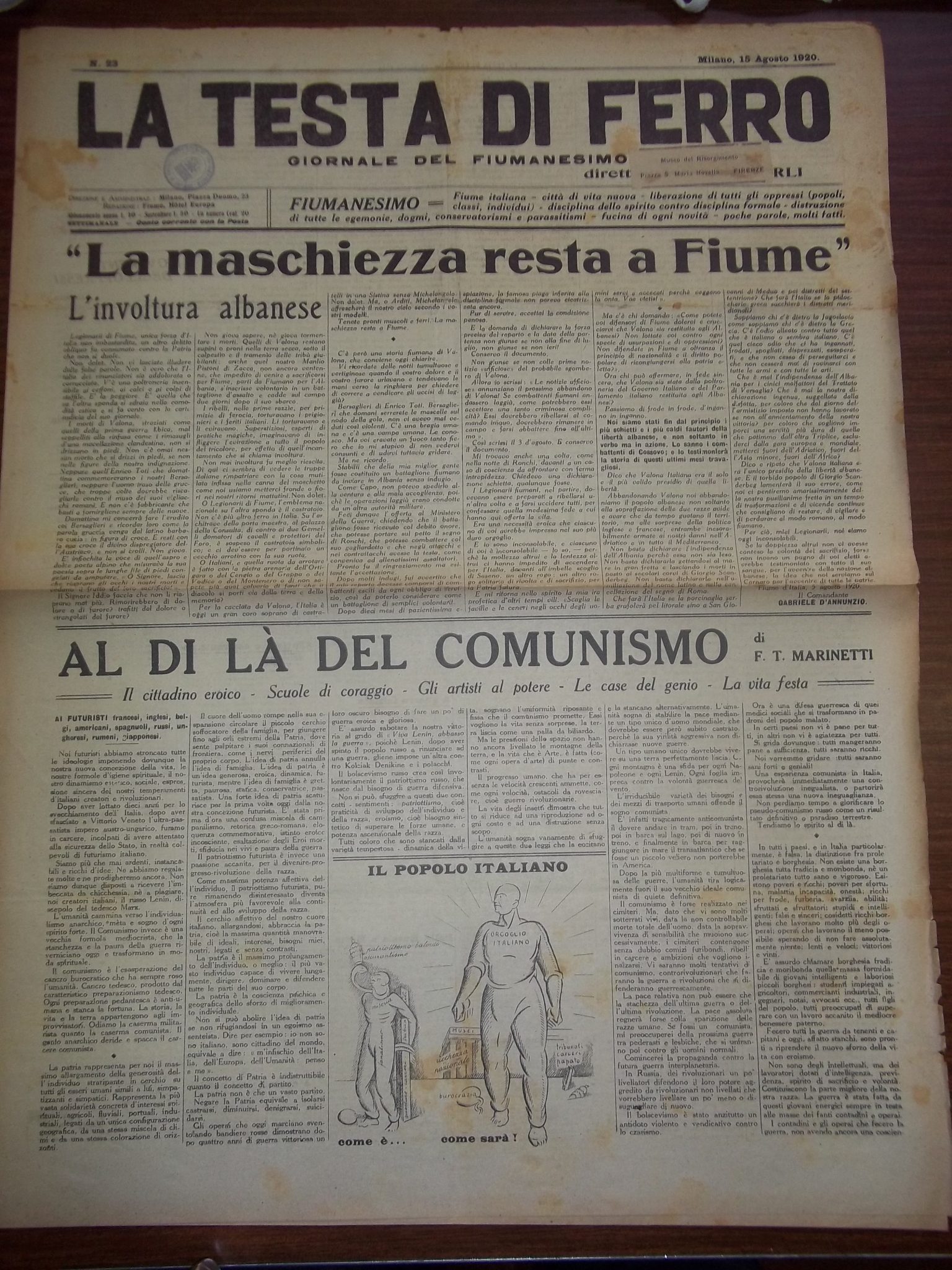
The Fiume Enterprise was a truly revolutionary project, represented by the magazine “La Testa di Ferro”
In recent decades, historical research has attempted to demonstrate how
Fiume Enterprise, and more generally to political D'Annunzioism, should be recognized as an autonomous and complex phenomenology, irreducible to a mere anticipation of fascism, highlighting, in addition to the irredentist and patriotic vocation, the social and libertarian aspects. Authors such as Ferdinando Cordova, Renzo De Felice, Emilio Gentile, Claudia Salaris and Giordano Bruno Guerri have in fact underlined how the most "hotheaded" fringe of the enterprise attempted to translate the Fiume climate into a true revolutionary project, aimed at overthrowing the regime of bourgeois democracy that had prevailed in the country since its Unification. In the development of this project, which was never put into practice, but whose general lines were shaped in the practice of the months between September 1919 and December 1920, feeding on the mystical nationalism of Gabriele D'Annunzio, the revolutionary syndicalism of Alceste De Ambris and the libertarian combativeness of futurists and arditi, the expression fiumanesimo was coined.
The Iron Head is the magazine that takes on the responsibility of representing Fiumanism, acting as the unofficial organ of the Fiume Command and offering a public voice to the legionaries of the “Città di vita”. Founded and directed by the daring Mario Carli, the greatest promoter of political futurism, its editorial staff was composed of veterans, daredevils and futurists: in addition to the signature of Filippo Tommaso Marinetti, the newspaper also features those of Alessandro Forti, Umberto Foscanelli, Cesare Cerati, Emilio Settimelli, Vincenzo Fani Ciotti known as Volt, Piero Belli, Leòn Kochnitzky, Guido Keller, Sergio Comisso. There is no shortage of publications of speeches and press releases by D'Annunzio and De Ambris, including the full text of the
Carnaro Charter and the Commentary on the Charter of the great trade unionist-revolutionary leader. Coming out on a weekly basis,
The Iron Head was published in Fiume from 1 February to 20 June 1920. With issue 21 the headquarters moved to Milan: D'Annunzio himself invited the editorial staff to move away, since the positions expressed by the weekly appeared too radical and could compromise the outcome of delicate political decisions. On the other hand, without any more controls,
The Iron Head passes fully
under the futurist aegis, multiplies the columns dedicated to art and literature and increases its radical charge. The publications will resume on August 8 and will last until April 17, 1921, with another interval between December 26, 1920 and January 30, 1921, coinciding with the events of the "Bloody Christmas". With its fifty-fourth issue, after various editorial events and a year and almost three months of life,
The Iron Head ceases its publications, barely surviving the fate of the enterprise. The fundamental ideological reasons of the
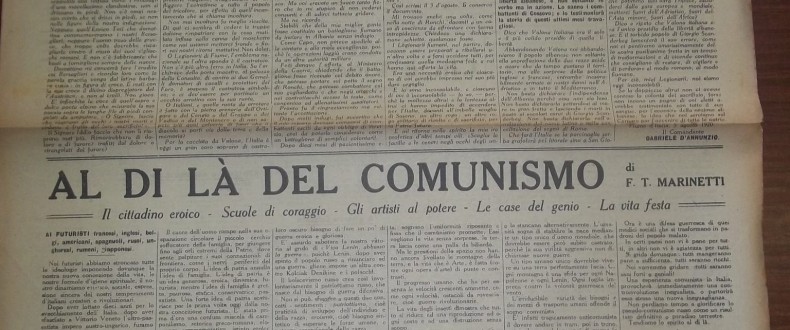
Iron Head are revealed above all in the articles by Mario Carli and Alessandro Forti. However, it is Marinetti who composes the most pregnant ideal manifesto of the weekly: on 15 August 1920 it in fact publishes
Beyond Communism, a text that completes the process of defining political futurism that began in 1918 with the
Manifesto of the Italian Futurist Party and continued in 1919 with
Futurist Democracy.
The task undertaken by Marinetti's text is the definition of a possible "Italian revolution". His position, however, is philosophical before being political. As in his ten-year career as a cultural agitator, Marinetti here in fact supports a Worldview activist, arationalist, tragic, which recognizes the transcendence of becoming and its eternal polemos. Since it is history itself, obeying the violent nature of becoming, that demands "obstacles to be overthrown, that is, revolutionary wars", the concept of revolution proposed by Marinetti is not tied to a specific political project to be realized, but coincides with a concrete, living, immanent reality: all phenomena participate in it, even those who would like to banish it. Since existence itself is revolutionary struggle, Marinetti writes, the utopia of perfect equality and eternal peace of Marxist-inspired communism is not only not achievable, since it is not possible to eradicate conflict from the intimate being of all things, but it is not even desirable, since it would be equivalent to the death of all living things. It is necessary, on the contrary, to second the movement of becoming, and therefore free individuals from the material and cultural shackles that limit all their creative potential. Marinetti therefore distinguishes a “dogmatic”, egalitarian, utopian, internationalist socialism from a “pragmatic”, libertarian, realist, patriotic one. Placing himself against any abstract cosmopolism, he maintains that an authentic Italian revolution cannot be achieved by modeling itself on similar foreign attempts, but only by choosing the homeland as its exclusive base of action. Italy should therefore have its own revolution, against the abuse of other countries, according to its historical needs and the characteristics of its people – which Marinetti paradoxically identifies in the attitude to “anarchic individualism”. He in fact thinks of the national community as “the maximum extension of the individual, or rather: the largest individual capable of living a long life, directing, dominating and defending all the parts of his body”. In the futurist conception, the individual is strengthened and, we could say, realized only as a post-human node of relations with the other from himself. But the other closest and most familiar to us is, according to Marinetti, our compatriot: for this reason he promotes a class alliance, inviting the proletariat and the middle class to fight side by side the social and national revolution. He therefore proposes to abolish, once power has been obtained, all the “past” institutions and to found new ones, more suited to the time of futurism, so that the Italian genius can create a “marvelous anarchic paradise of absolute freedom”. The futurist revolution in fact intends not only to satisfy the material conditions of the indigent, but also to elevate their spirits, so as to “give everyone the will to think, create, awaken, renew, and destroy in everyone the will to suffer, conserve, plagiarize”, fully realizing their existential and creative potential. This is Marinetti's final objective: the conquest of power by the “proletariat of geniuses”, that is, the people understood as composed of potential artists, and therefore the perfect transmutation of life into art.
The literary evocation and the political program of Beyond Communism summarize in a nutshell the overall concept expressed by La Testa di Ferro. Some other articles that reflect on a possible Fiume road to socialism are those that comment on the trade union clashes of the Biennio Rosso and those that attempt to analyze the Russian revolution of 1917. In the partial divergence of opinion of the article writers, the editorial staff of Iron Head overall applauds the mobilization of the masses, perfectly organized in the appropriation of the means of production, during the union clashes of the summer-autumn of 1920, but accuses the Italian workers' movement of having calmed down its original revolutionary demands by giving in to Giolitti's mediation and being content to obtain economic favors. Instead, it would have been its historical duty, the "Iron Heads" sternly observe, to participate in the overthrow of the liberal regime side by side with the petty bourgeoisie, in the form of the union organization understood as a revolutionary and governing unit. It is therefore in the internal struggle within socialism between maximalists and reformists that the revolutionary middle class, to which the Fiume legionaries belong, could insert itself, flanking the radical faction to direct it against the upper bourgeoisie.
The articles "Our Bolshevism" and "The Little Bolshevik Father" by Mario Carli, and "Fiume and Bolshevism" by Alessandro Forti, demonstrate how the editors of La Testa di Ferro nurtured a sincere sympathy for Soviet Bolshevism, capable of adapting the revolutionary ideal to the historical reality of Russia. The aforementioned readings clearly distinguish between Italian socialism, which is gravely accused of preaching the subversion of society only in words and of hindering those, like D'Annunzio's legionaries, who believed in the revolutionary motives of the Great War, and Russian Bolshevism, courageously prepared to seize power through violence and to overcome in practice the suffocating utopia of "dogmatic" socialism. Giovanni Grandi's " New Words on Russia " also bears witness to this point of view, observing how:
“For the skeptical and unprejudiced witness, it is not a banal spectacle offered by internationalists who defend every inch of the soil of their homeland, socialists who have put socialism on trial and killed the democratic principle and who, with means that no tyranny has yet dared to adopt, have created a State that is a monument elevated to the most aristocratic spirit – to the aristocracy of thought and creative will.”
The Iron Head then explicitly opens up to demands for social justice and direct democracy, where he claims he wants to contribute to "lifting the material and spiritual misery of the masses" and "calling, alongside the 'elites,' also the representatives of the 'numbers' to participate in collective life, to decide their own interests and their own destiny" ( Our Bolshevism ). No one, Carli argues, can understand more than an officer who has fought in the trenches how precious decisions made as a group, on equal terms, are on the battlefield. The same concept is echoed in The New Order of the Liberator Army , drafted by Giuseppe Piffer and D'Annunzio during the 1920s; and it is also the same principle of the soviet, whose system can, according to Carli, be extended to every area of social organization. "Once again: let us look to the East!" he writes in concluding Our Bolshevism :
“Between Fiume and Moscow there is perhaps an ocean of darkness. But indisputably Fiume and Moscow are two bright shores. A bridge must be built between these two shores as soon as possible.”
di Daniel Meregalli – 30/05/2021
 Language
 English